GR00T 2 predicts the next few seconds of video before it moves. A robot running it learns skills from human demonstrations, then carries those skills to bodies that never practiced the task.
It imagines the task before it moves
One diffusion transformer generates the future video and the action chunk together. It reads recent camera frames, the instruction and the robot’s own state, executes the chunk, and then repeats the loop until the task ends.
NVIDIA frames the model as its System One layer, the fast half of a two-part mind.
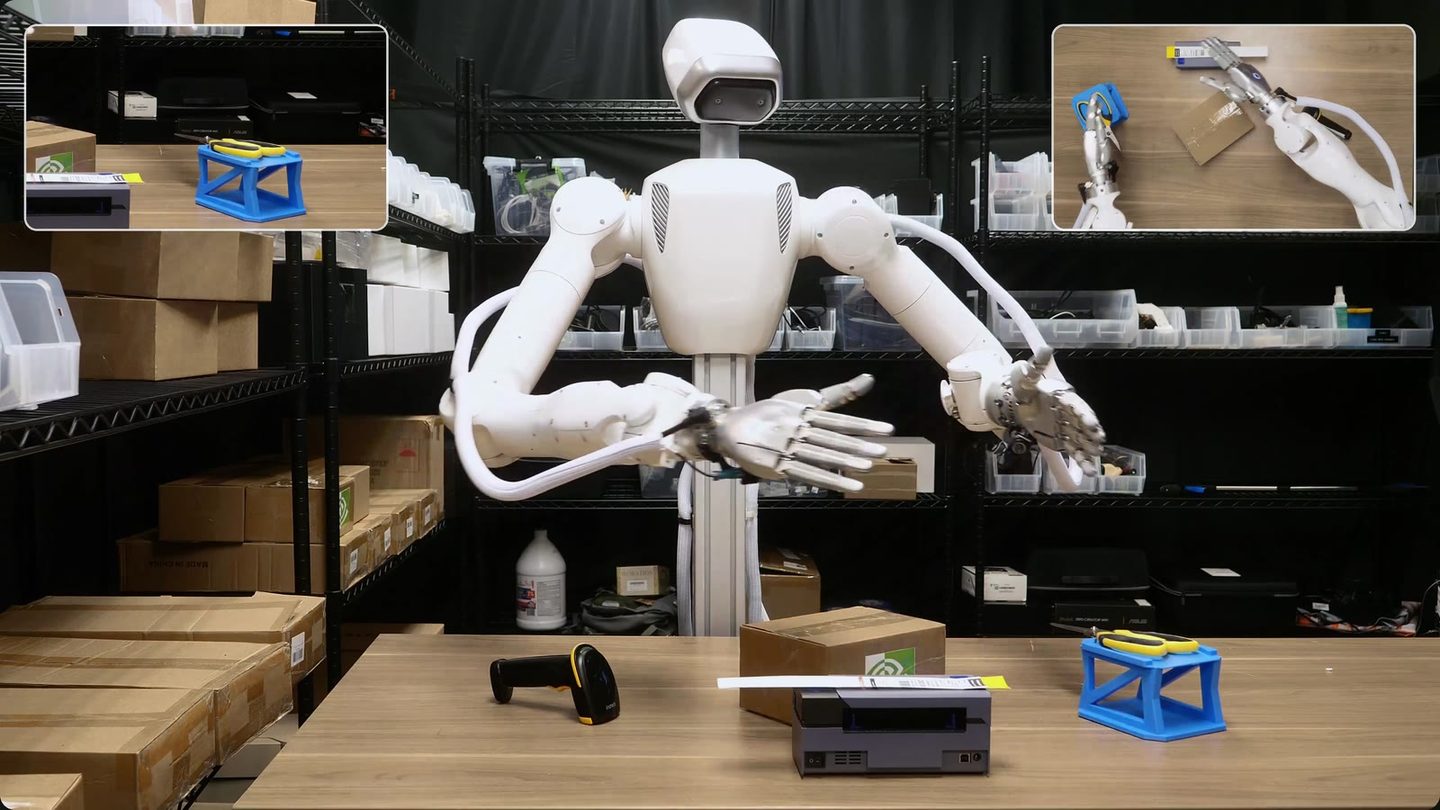
The design runs on three kinds of body at once: parallel grippers, dexterous hands and full humanoids, with small per-robot heads turning one shared plan into motor commands for each machine. Prediction comes before motion here. Earlier GR00T models mapped sight and language more directly onto movement, and the new generation instead builds on Cosmos, NVIDIA’s world-model platform, so the plan starts from how the scene should change.
Skills move between bodies
Pretraining mixed 402,730 hours of first-person human video, 10,184 hours of handheld gripper demonstrations across 2,897 tasks, and 23,500 hours of robot teleoperation from arms, dexterous hands and one humanoid.
NVIDIA calls the transfer X-Adapt. A skill enters through whichever data source has it, and the target robot never has to demonstrate the task itself before running it.
The robot hours span YAM and Franka arms, Sharpa and Wuji hands, and the Unitree G1 humanoid.
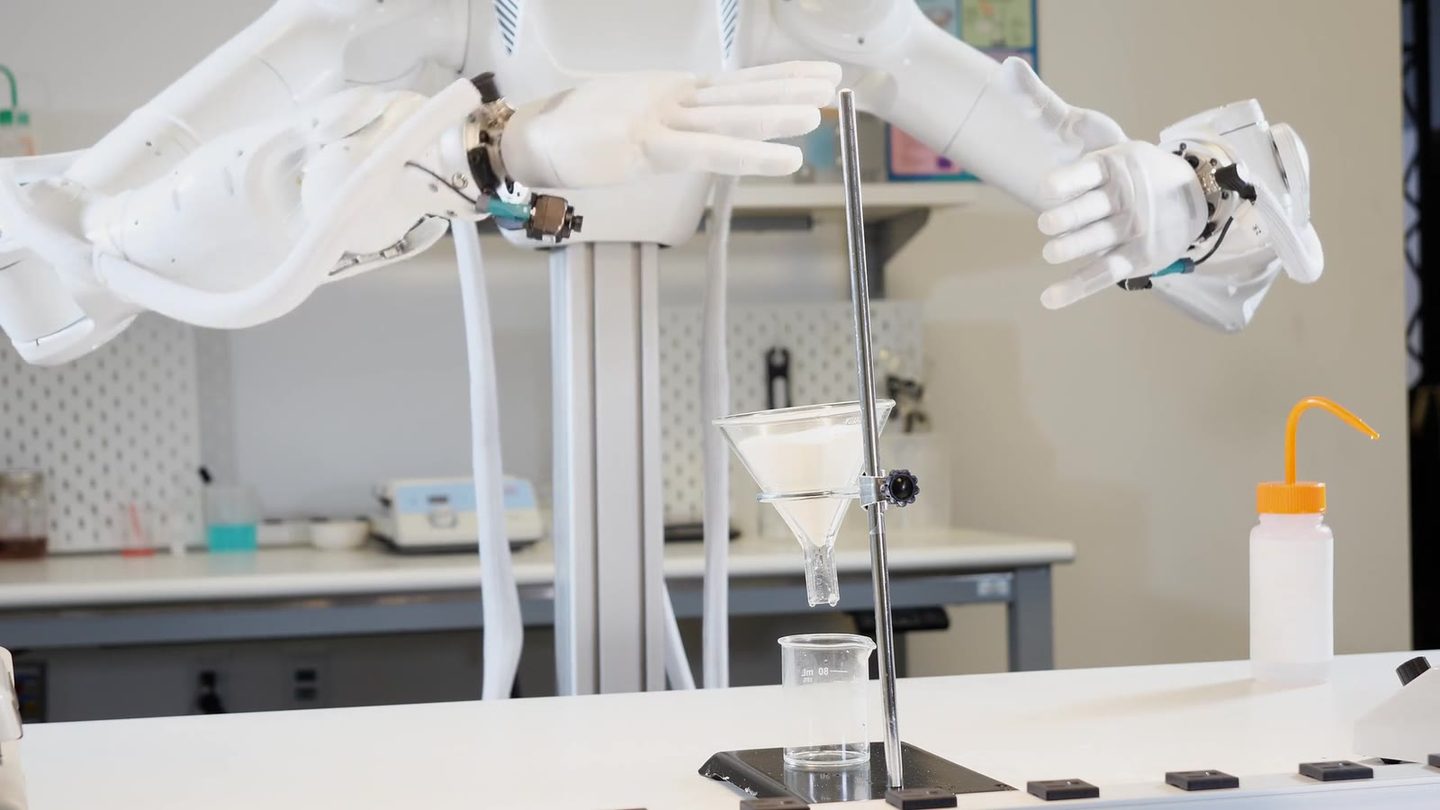
Shown only human demonstrations, a two-handed robot lines a lab funnel with filter paper and wets it with a wash bottle in 65% of trials.
A handheld gripper taught the YAM arm to assemble a toy dump truck end to end in 60% of trials, on a job that runs four minutes end to end. A wearable hand exoskeleton taught robot hands to fix a banana-yogurt breakfast and strike a match to light a lamp.
The human side of that mixture isn’t locked away either: 100,000 hours of the egocentric footage sit on Hugging Face as Human-1M-100K, where any lab can pull the same training material. Researchers can test their own robots against the same mixture instead of starting from a blank dataset.
Strong transfer, soft first attempts
On 50 tasks the target robot had never practiced, GR00T 2 succeeds in 40% of trials straight from the instruction, and it completes 40 of those 50 tasks at least once. The misses skew toward execution rather than intent: the model runs the right steps in the right order, and a single step falls short on precision. Zero-shot is a starting point, not a spec.
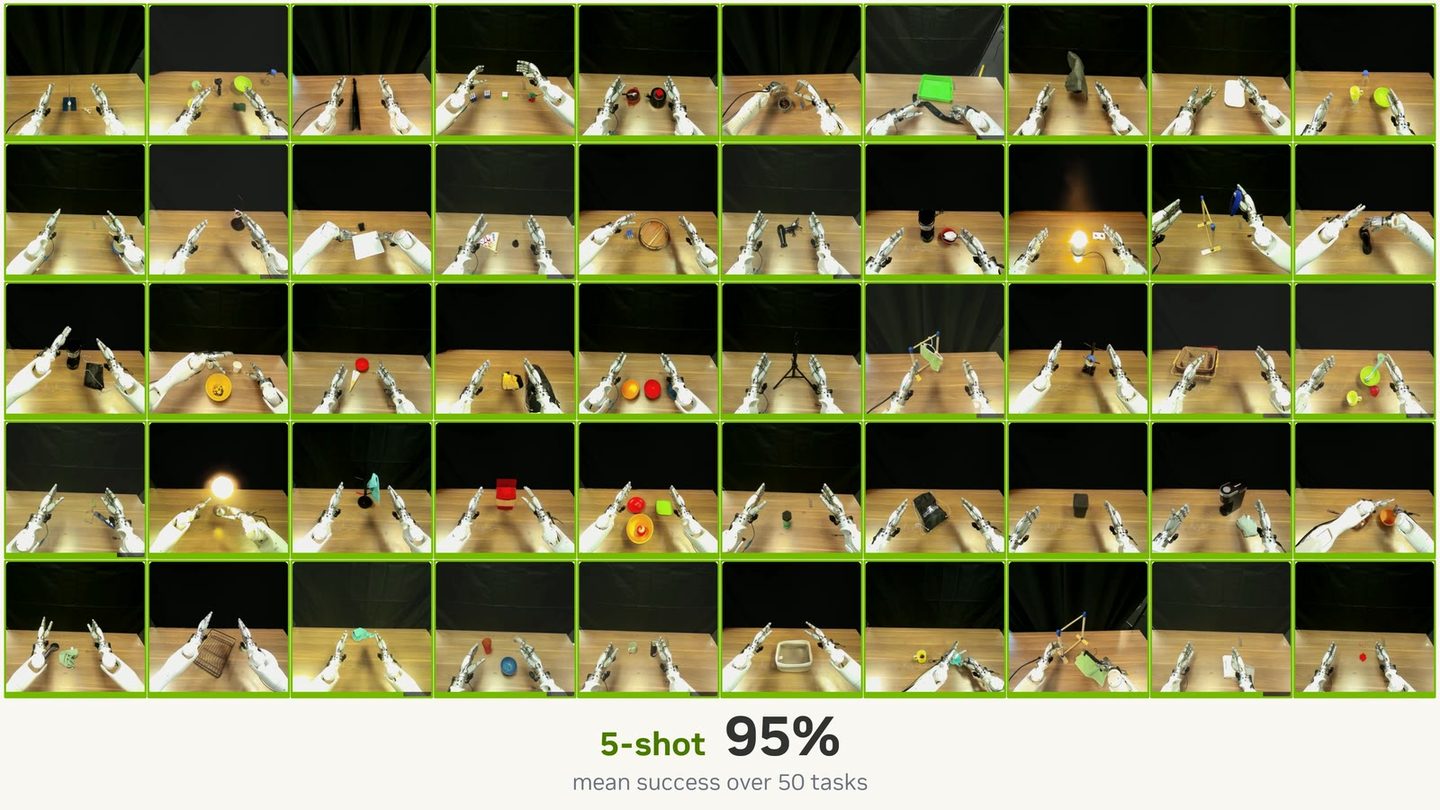
A little robot data closes most of that gap. One demonstration per task lifts average success to 71%, and five demonstrations, under three minutes of robot data in total, lift it to 95% after a single 30-minute fine-tune on one RTX 5090. The same post-training puts two 22-DoF Sharpa hands to work seating GB300 memory modules at 85% and assembling a toy truck at 65%. Reinforcement learning on the real robot then lifts three contact-rich insertion tasks to between 88% and 96%.
Across the public leaderboards, the model sits inside the top three in both the vision-language-action and world-action categories on RoboCasa365, RoboLab, RoboDojo and MolmoSpaces, with several outright wins.
A reasoning model gives the orders
GR00T 2 is the System One half of the stack: fast, reactive skill execution that runs on the robot itself. A frontier reasoning model plays System Two through the WAM API, breaking a long job into steps, checking progress and calling GR00T 2 as a tool whenever a step needs hands. The split keeps deliberation off the motion loop.
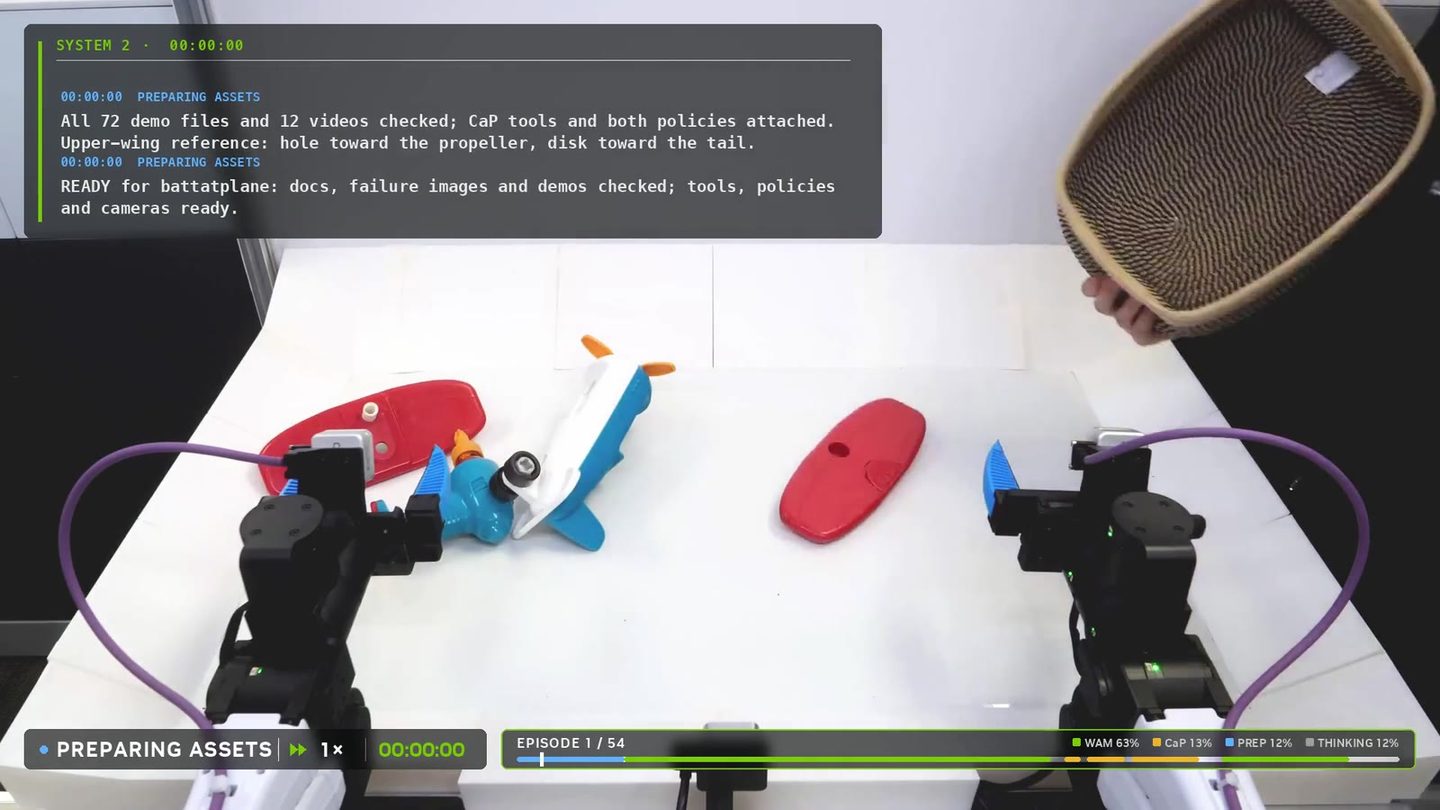
Across 300 back-to-back toy assemblies, the paired system finished 292, recovering from dropped parts and stalls along the way. The agent repairs the scene with a code-written skill when progress stalls, then hands control back for the precision work. The same pairing inserts five Ethernet cables in sequence in 19 of 20 runs. Visual steering sharpens the handoffs further: when the planner marks grasp and release points on the camera view, the YAM arm follows instructions 92% of the time, up from 40% on the instruction alone.
Turbo shrinks it onto a humanoid
GR00T 2 Turbo trades size for speed: a smaller 2-billion-parameter transformer and a tighter video encoding let it run onboard a Unitree G1 humanoid, planning whole-body motion on the robot’s own Jetson Thor at 124 milliseconds per prediction. Through the SONIC whole-body controller, that humanoid scoops and serves popcorn in all 48 trials and clears a table of mixed objects in 93% of trials.
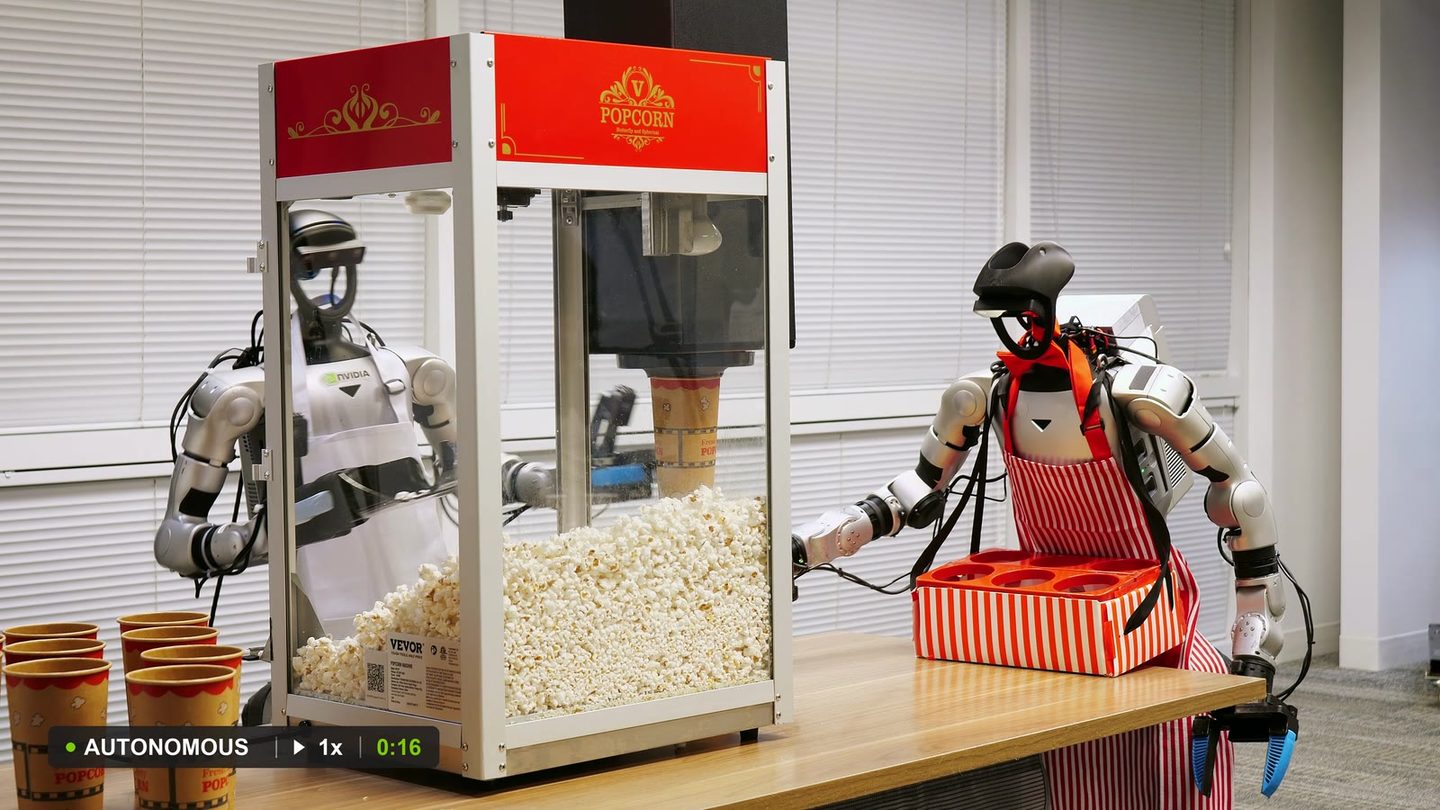
Industry is already testing the full-size model: Nexuni is trying it on robotic laundry handling, Foxconn is applying it to factory automation for server manufacturing, and Siemens is evaluating it across industrial work. MicroAGI runs a post-trained version swapping Ethernet cables with a YAM arm. The release matches the research posture: the agentic framework, simulation engine, annotation engine, hardware designs and 100,000 hours of training data are already public. The model weights and the X-Adapt recipes follow in December.