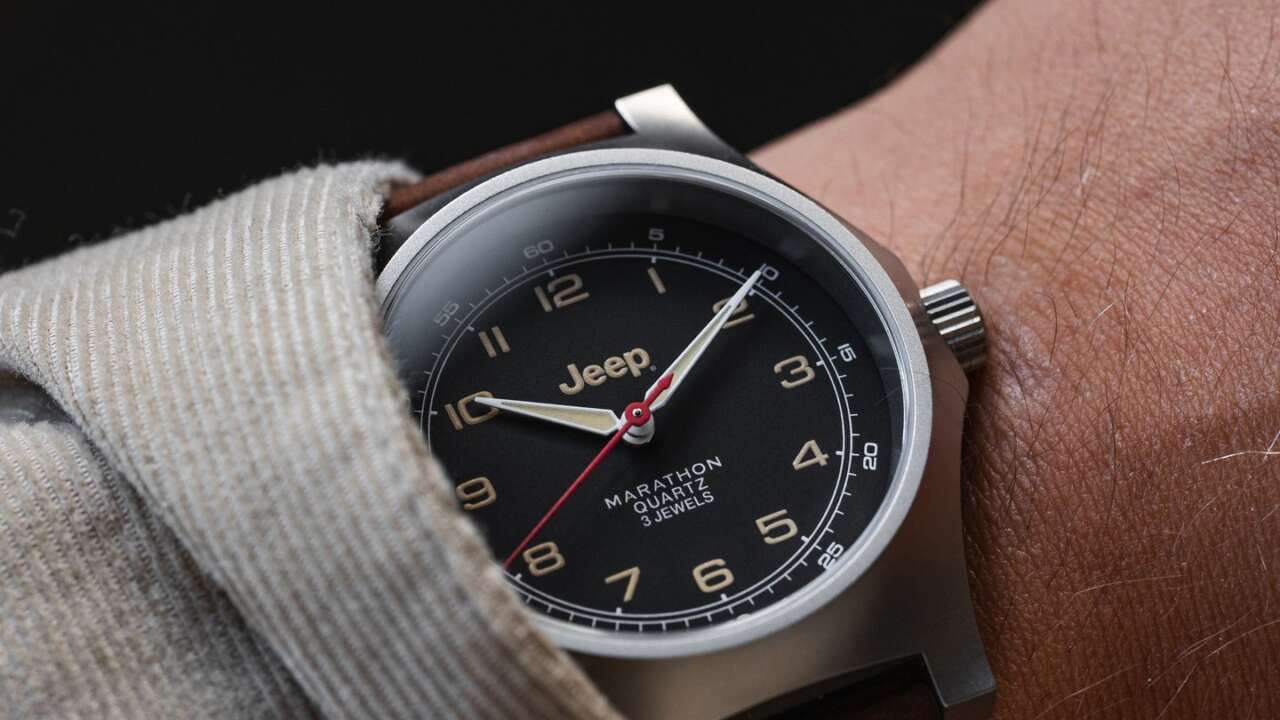
Jeep’s name now sits on four Marathon field and dive watches, two Willys field models and two Rubicon divers, each built around a 41mm steel case and sold under one shared banner. The two brands share a supply history that runs back to 1941.
Marathon frames the line as a tribute to that shared past, with the Willys pair taking their cues from the Willys MB and the Rubicon pair from the modern Wrangler Rubicon. The movements are Swiss in all four, ETA quartz in two and Sellita in the other two, with the mechanicals split between hand-wound and automatic, and the split is price and purpose.
Prices run from $540 for the Willys quartz to a $2,100 list on the automatic GSAR, with a 10 percent cut live across all four on Marathon’s store right now. Every model shares the 41mm case, the 48mm lug-to-lug span and a 20mm lug width, so straps swap across the line. The four models split evenly, two movements in each family and one case size across the whole series.
Jeep x Marathon 41mm Rubicon GSAR, Diver’s Automatic, Type II
Sellita SW200-1 automatic · Tritium and MaraGlo illumination · 300m water resistance
Price: $1,431.08
Where to buy: Buy on Amazon
The Willys pair keeps the 1941 brief
Both Willys models wear a fresh black dial with fully lumed Aged-Radium colour numerals, a modernized treatment of the dial Marathon shipped on its original WWII-issued field watch, with type borrowed from the Wrangler 1941 Limited Edition. The case is 316L stainless steel with a parkerized finish that cuts reflectivity and resists corrosion, and the crystal is sapphire.
The numerals glow in MaraGlo, as do the hour and minute hands. It looks like issued kit, not costume.
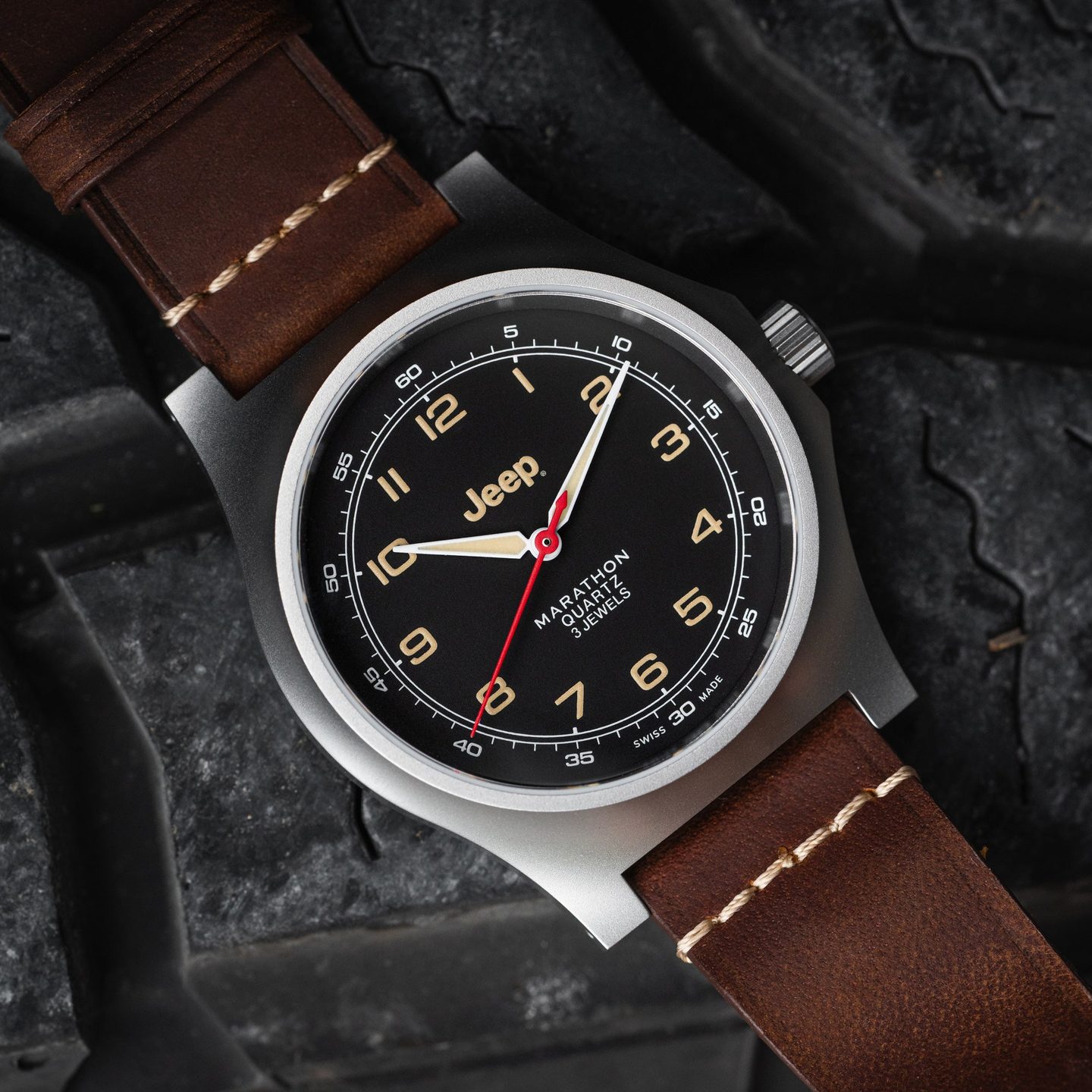
The hand-wound SSGPM runs a Swiss Sellita SW210-1 with 18 jewels in an 11mm case, and no date window to break the dial’s symmetry. The SSGPQ quartz runs an ETA F06.402 HeavyDrive-PreciDrive movement that Marathon rates at plus or minus 10 seconds a year. Both ride on a three-piece Crazy Horse leather strap kit, and both stop at 5 ATM, so swimming stays off the schedule.
Marathon builds the Willys pair to US Military Standard MIL-PRF-46374 G, the General Purpose spec its field watches have carried since the GG-W-113 era of the 1960s.
Hand-wound or quartz, the tradeoff is daily
The mechanical asks for a winding ritual every day or two and gives back a clean, battery-free dial. The quartz asks for nothing between battery changes and holds time to seconds a year, though it trades the mechanical’s service life for an eventual battery swap. Pick the ritual or pick the accuracy.
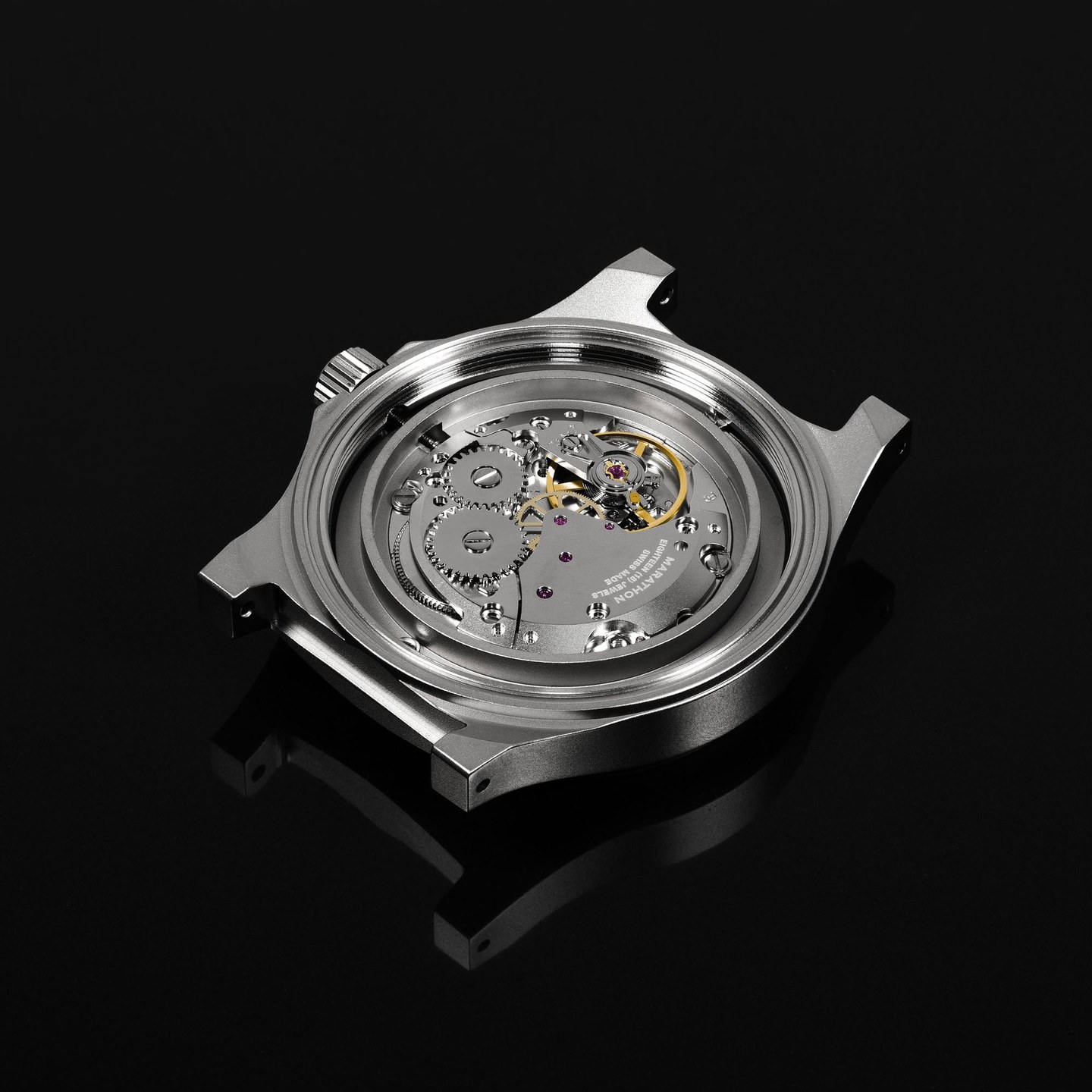
Under the same Willys case, the movement is the only real choice, because case, dial, strap and water resistance stay identical across the SSGPM and the SSGPQ. Marathon prices that choice at $162, with the mechanical at $702 and the quartz at $540 during the current 10 percent cut. The spec tables underline the point, since everything except the movement column reads identical between the two watches. The wrong pick still keeps time, it just fights your habits.
The Rubicon pair is built to get wet
Tritium gas tubes and MaraGlo light the dial and the full handset, so the watch reads in the dark without a charge from a flashlight. The dial’s red line works as a 15-minute count-up, a detail Marathon lifted from Jeep dashboard instruments rather than from dive-watch convention. A seven-slot grille is engraved into the case side, the Willys star sits on the crown, and the case back carries the words Go Anywhere, Do Anything.
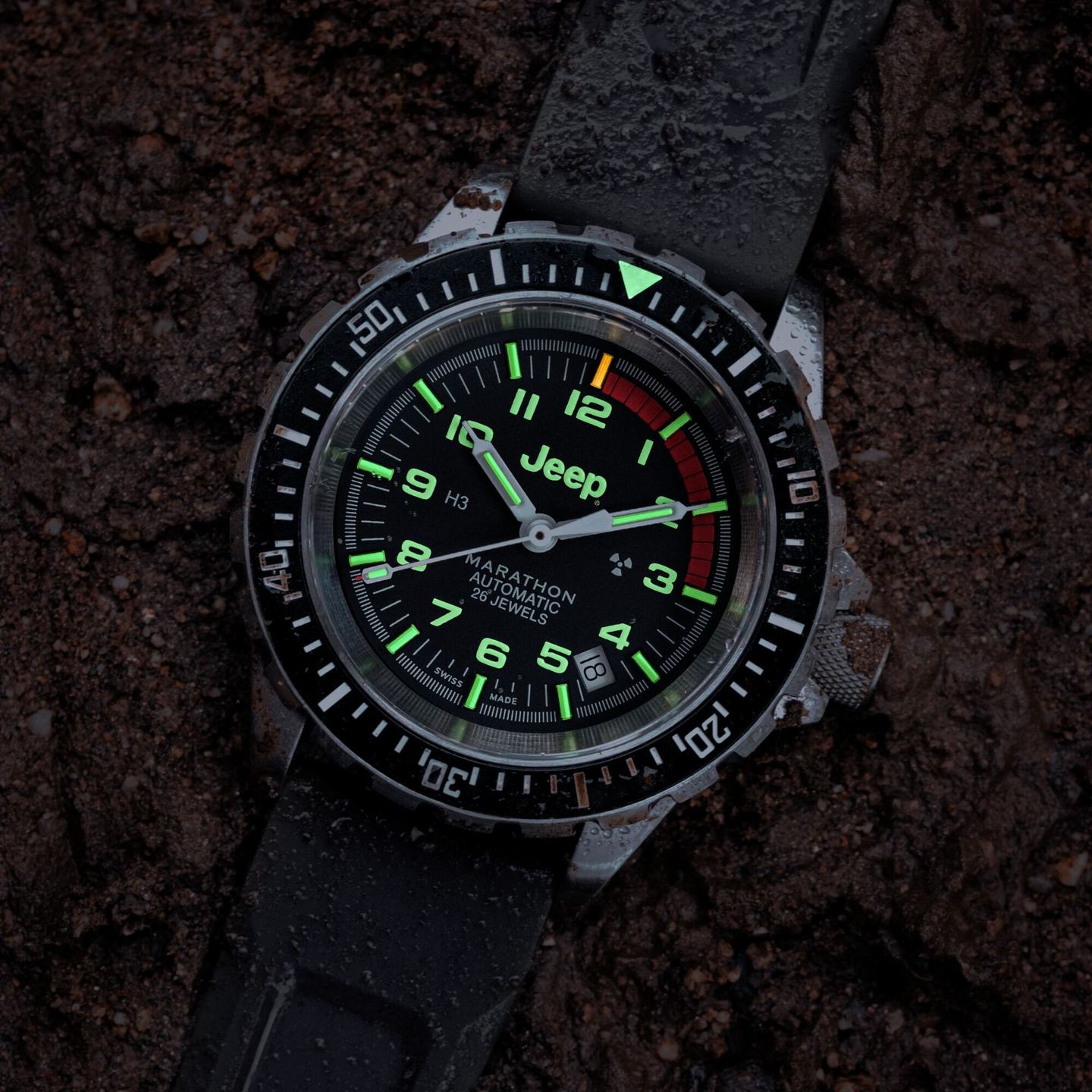
The Rubicon case keeps the 41mm footprint and stretches to 13.5mm thick, adding a 120-click unidirectional dive bezel, a screw-down crown and 300 meters of water resistance the field pair doesn’t carry. This is the one that dives.
The GSAR’s SAR line was built to Canadian government requirements for search and rescue work, the same issued-watch world our military watches guide dug into.
Each Rubicon ships with a three-piece rubber strap kit in OD Green, and each case back carries a unique serial number beside the Since 1941 mark. The bezel’s minute track runs the full 60, fully hashed in the SAR pattern Marathon has used since the early 1990s.
Automatic money or quartz sense
The GSAR runs a Swiss Sellita SW200-1 automatic with 26 jewels and Incabloc shock protection, while the TSAR runs an ETA F06.412 quartz rated at plus or minus 10 seconds a year. The GSAR is the flagship here. Both take the same three-piece rubber strap kit and the same engraved details, grille, star and motto included, and most buyers will cross-shop this pair first.
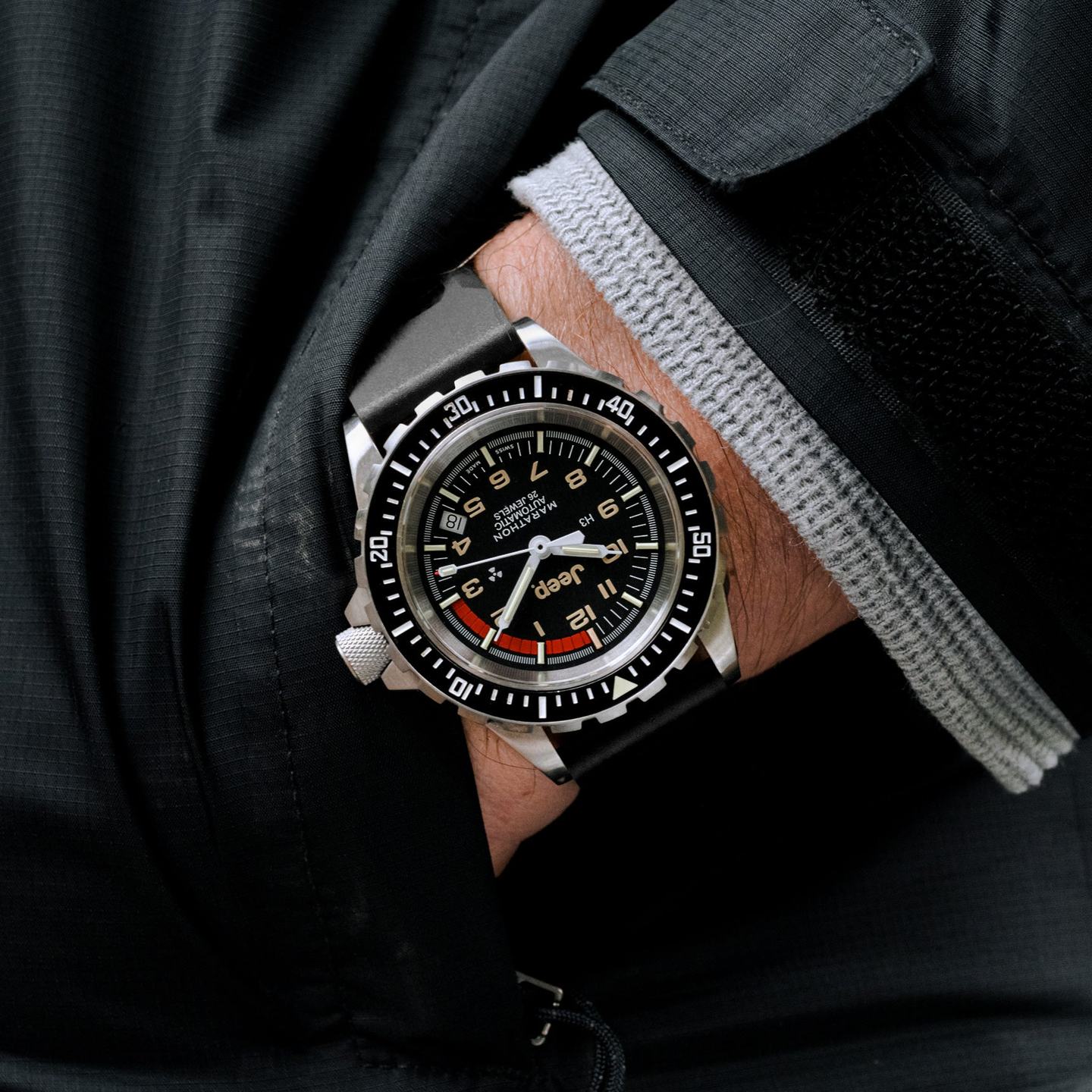
The GSAR is the one to hunt on price, since Amazon’s $1,431.08 undercuts Marathon’s own $1,890 sale figure by more than $450. The TSAR keeps the same case, bezel and tritium as the GSAR, so the $405 gap buys the automatic movement and nothing else. That gap is the cleanest decision in the line.
Both divers share the field pair’s 48mm lug-to-lug span and 20mm lug width, so straps carry across all four models.
Jeep x Marathon 41mm Willys SSGPQ, Officer’s Quartz, Type II
ETA F06.402 quartz, plus or minus 10 seconds a year · Aged-Radium MaraGlo numerals · Crazy Horse leather strap kit
Price: $540.00
Where to buy: More details at Marathon
The buyer here wants a real military-spec watch with a story that checks out on the maker’s own page, and the GSAR at $1,431.08 on Amazon is the strongest version of it. The Willys SSGPQ at $540 is the alternative, and everything between those two price points is a movement preference, nothing more.