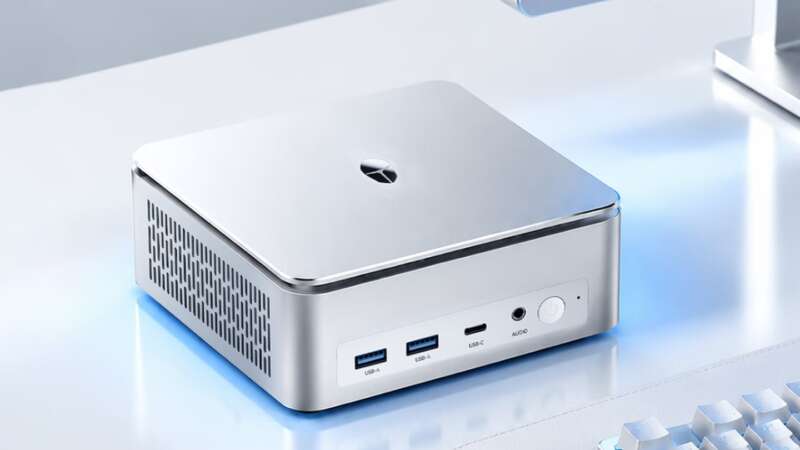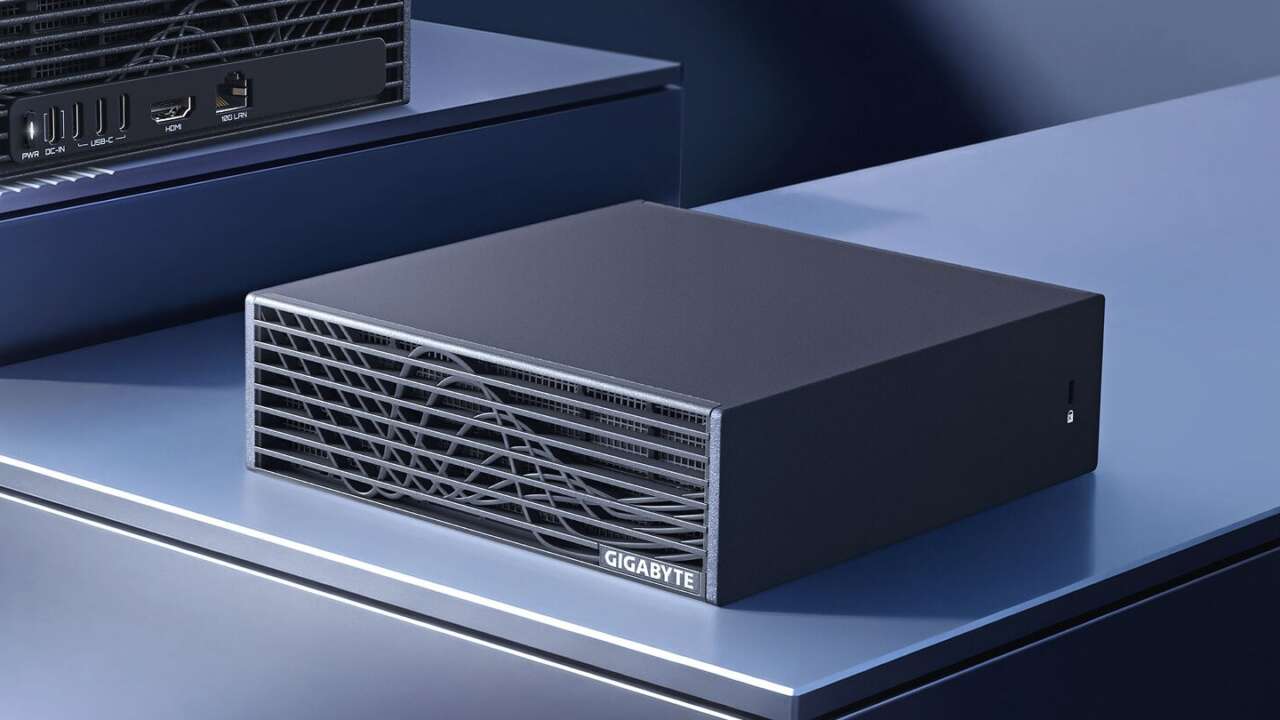
One liter of chassis holds the whole machine. Gigabyte’s AI TOP AERO runs Nvidia’s RTX Spark N1X Superchip, pairing a 20-core Grace CPU with a Blackwell RTX GPU and up to 128GB of unified memory, and it does the work on your desk instead of in a cloud region you will never visit. It is a desktop in the literal sense, too: no battery, no hinge, no screen of its own, just the box and the work.
Gigabyte calls the Aero a Personal AI Studio, and the positioning is specific: local AI development, content creation, and gaming on one Windows 11 machine.
Models load locally, data stays on local storage, and inference runs a few feet from your chair.
Gigabyte AI TOP AERO
NVIDIA RTX Spark N1X Superchip · Up to 128GB of LPDDR5X unified memory · One-liter chassis
Price: TBD
Where to buy: More details at Gigabyte
Grace and Blackwell on one chip
The N1X Superchip integrates the 20-core Nvidia Grace CPU and the Blackwell RTX GPU on a single piece of silicon. Nvidia’s desktop spec for the platform counts 6,144 GPU cores, a 140W thermal envelope, and up to one petaflop of FP4 AI performance, with support for models up to 120 billion parameters and context windows up to one million tokens.
RTX Spark already powers a wave of laptops and desktops, including the machines in our RTX Spark buyer’s guide. Those systems chase thin-and-light designs. The Aero stays plugged in on a desk, trades the battery for a fixed power budget, and spends that budget on sustained loads instead.
The Aero also joins Gigabyte’s existing AI TOP lineup, which already runs from the compact AI TOP ATOM to larger desktop systems.
It is the first of the family built on RTX Spark and Windows, and that puts it in front of a wider audience: individual developers and creators working at home, not only teams with a training budget.
128GB of memory the CPU and GPU share
Unified memory is the spec that shapes this machine. CPU and GPU draw from the same pool of LPDDR5X, up to 128GB, so a model loads once and both processors work on it in place. Nothing gets copied across a bus, and nothing gets split apart to squeeze into a graphics card’s separate memory.
Scale is where that pool earns its keep. Models in the 120B class need far more room than a desktop graphics card carries, and the Aero’s ceiling is the platform’s ceiling: the full 128GB, available to the GPU as working space for inference, fine-tuning, and testing.
It also changes iteration speed. A test that waits in a cloud queue runs here the moment you ask for it, and a failed experiment costs minutes at your own desk instead of time on somebody else’s hardware.
Storage runs up to a 4TB PCIe Gen 5 SSD, fast local room for model weights, datasets, and project files. A 10GbE Ethernet port moves those files across a wired network, and Wi-Fi 7 covers the wireless side.
Everything else on the spec sheet supports that memory pool.
Ports live on one rear strip
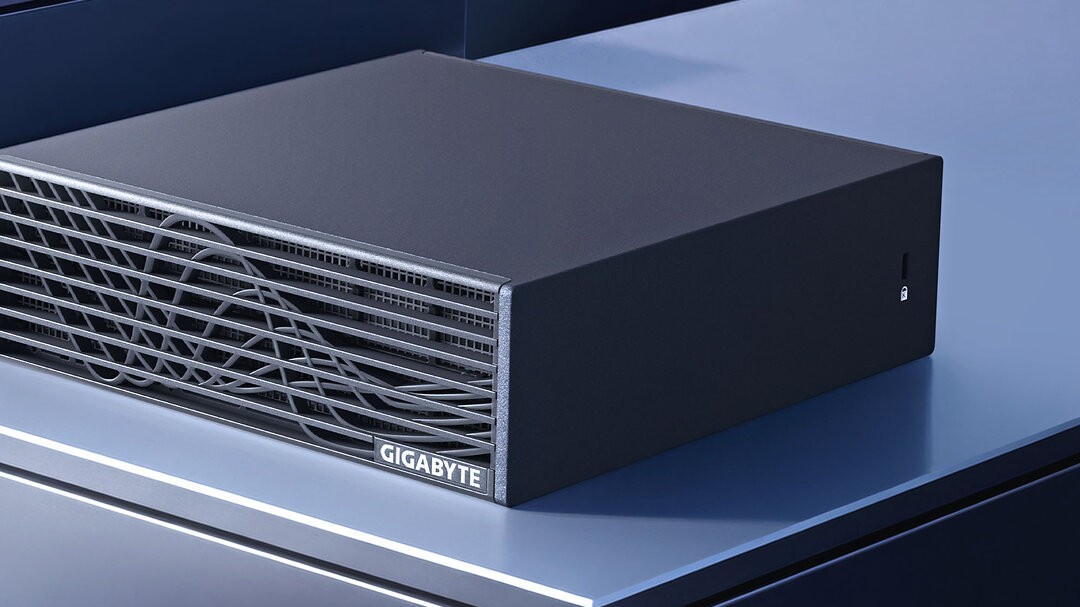
Every wired connection sits on the back panel: the power button, DC input, four USB Type-C ports, an HDMI port, and the 10GbE jack. The flanks stay clean, down to a Kensington lock slot on the side, and the front face is all grille.
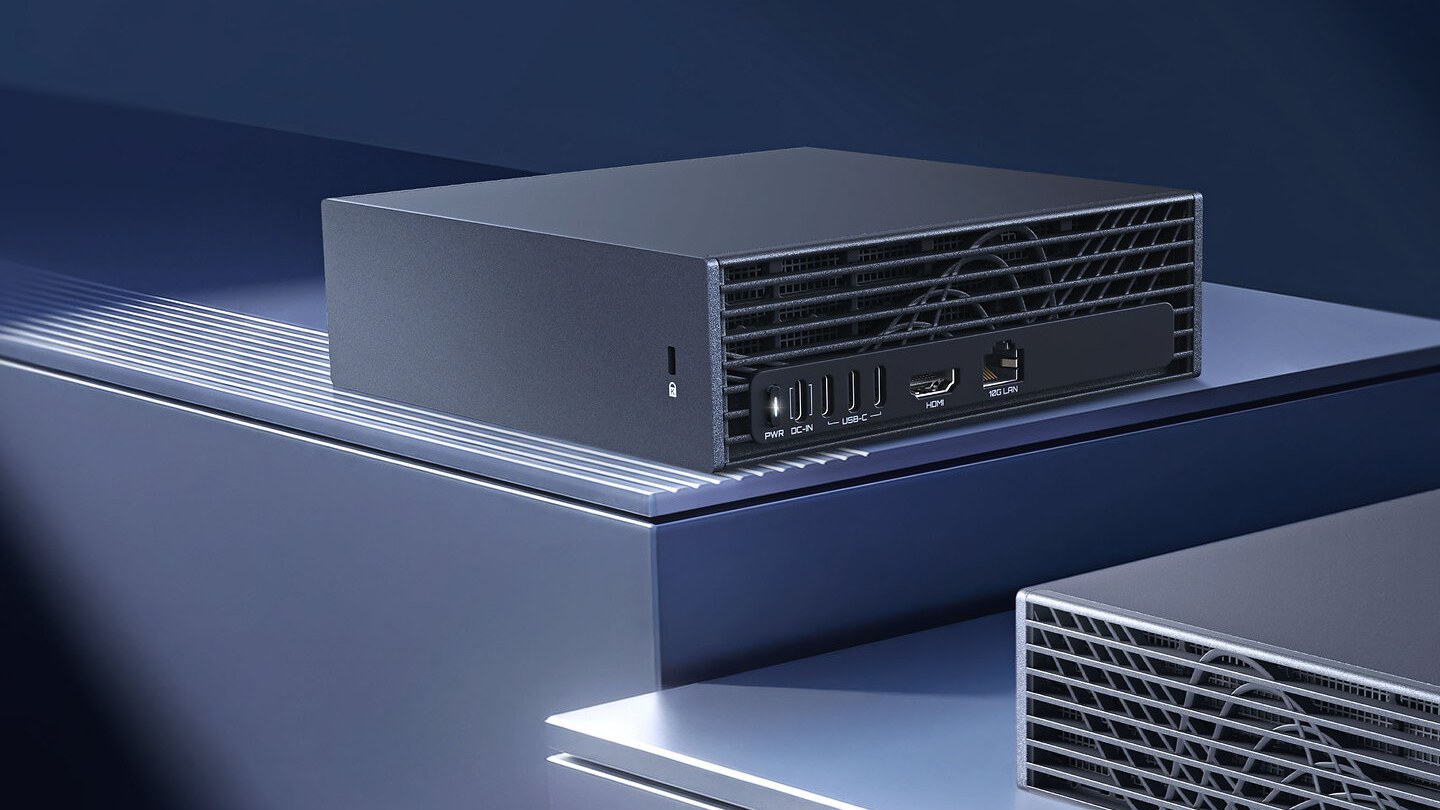
Gigabyte designed the cooling for sustained work. Inference runs, renders, and generation jobs hold a system at full load for hours, and a one-liter chassis has very little air to work with. The vented panels front and back are the visible half of that thermal design.
Gigabyte publishes no acoustic figures for the Aero, so how loud a liter of cooling gets under load stays an open question.
The toolkit is Nvidia’s local AI stack
CUDA underpins the software story.
Developers build, prototype, and fine-tune on it directly, and Nvidia’s Nemotron models give them open models ready for local inference and agentic work. LM Studio and Ollama round out the day-to-day tools for loading a model and testing what it does.
Nvidia PAIR, the Personal AI Router, extends the Aero across a home or studio network, distributing inference tasks to available devices nearby. Long-running agents can sit on the machine around the clock, working against your own files while your main workstation stays free.
Creators get their own lane. ComfyUI builds generative workflows, Nvidia Broadcast sharpens audio and video for recordings and calls, and RTX Video improves video processing and playback quality inside production work.
Games ride the same GPU
The Blackwell GPU supports DLSS 5 in compatible games, bringing neural rendering with more detailed lighting and materials to supported titles. Development in the morning, a render queue in the afternoon, a game at night: the Aero is built to stay the only box on the desk through all three.
| Chip | NVIDIA RTX Spark N1X Superchip |
| CPU | 20-core NVIDIA Grace |
| GPU | NVIDIA Blackwell RTX, 6,144 cores |
| AI performance | Up to 1 petaflop FP4 (platform figure, Nvidia) |
| Memory | Up to 128GB LPDDR5X unified, shared by CPU and GPU |
| Storage | Up to 4TB PCIe Gen 5 SSD |
| Chassis | Approximately 1 liter |
| Ports | 4x USB Type-C, HDMI, power, DC input (rear panel) |
| Networking | 10GbE Ethernet, Wi-Fi 7 |
| Software | Windows 11, CUDA, NVIDIA Nemotron, LM Studio, Ollama, NVIDIA PAIR, ComfyUI, NVIDIA Broadcast, RTX Video, DLSS 5 |
Gigabyte AI TOP AERO
20-core Grace CPU with Blackwell RTX GPU · Up to 4TB PCIe Gen 5 SSD · 10GbE and Wi-Fi 7
Price: TBD
Where to buy: More details at Gigabyte
Gigabyte dates the AI TOP AERO launch to November 10, 2026 and leaves regional configurations, pricing, and availability to its local announcements. So the hardware case is complete and the price case is blank.
One liter, 128GB of shared memory, and Nvidia’s full local AI stack is a strong opening position for the RTX Spark desktop class, against a field of Spark laptops that all compromise somewhere on thermals or ports. The number Gigabyte publishes next decides how wide the audience gets.