Every scuba diver plans around one number: how fast the tank empties. Depth, cold, current, and workload all pull on it, and the dive ends when the gas does. A soft robotic exosuit built for divers has cut the rate at which wearers breathe by nearly 30% in human testing, and that number points straight at the one thing every diver wants more of: time on the same tank.
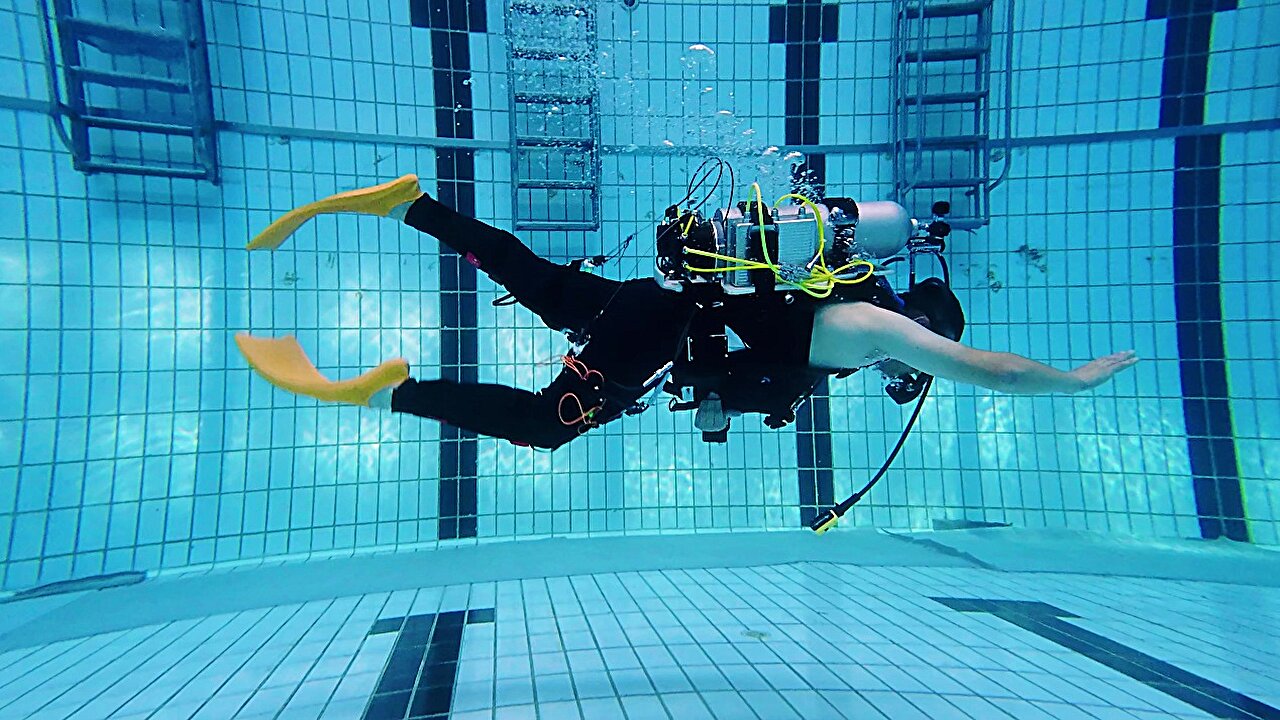
PEAKED is the system, short for Performance-Enhancing Assistive Kicking Exosuit for Diving, from Professor Wu Xinyu’s team at the Shenzhen Institute of Advanced Technology, part of the Chinese Academy of Sciences.
Wu’s team lays out the design and the evidence in a Focus article in Science Robotics, and it’s their most developed device: a soft exosuit worn at the hips that helps the legs through the kick instead of fighting them.
What breathing 30% less air actually buys a diver
Researchers measured respiratory minute volume, the volume of gas a diver breathes each minute. With the suit assisting, that volume fell 29.77% during flutter kicking, the standard finning most divers use to get somewhere. It fell 25.70% during frog kicking and 18.35% during underwater walking along the bottom.
Run the arithmetic and the implication is plain. Breathe about 30% less gas per minute at the same pace and the same tank empties about 30% slower, which works out to roughly 1.4 times the bottom time before the gauge reaches the reserve you planned around. A working dive that used to end at 40 minutes stretches toward 55 at the same workload.
That’s what the lab number implies, stated as arithmetic rather than a promise. Tests ran at set paces under controlled conditions, and a real dive adds depth, cold, current, and task load, all of which move actual consumption around. Hip assistance takes a real share of the work out of every kick, and the gauge notices.
Water pushes back in both directions and the suit is built for that
An exoskeleton designed for land starts from the wrong problem. Warehouse and factory suits mostly help a body carry weight against gravity, and underwater that job mostly disappears, because buoyancy carries the load instead. What water adds is resistance, and it works on the leg through nearly the whole kick, on the way out and on the way back.
Its design is built around that difference. It’s soft and compliant rather than a rigid frame, so the legs keep their large, natural range of motion, and it assists both halves of the movement, hip flexion as the leg swings one way and hip extension as it drives back.
Assistance must also match the movement. Structure, timing, and direction all change with the task, as the researchers note, because a flutter kick, a frog kick, and a walk along the bottom load the legs in different patterns, and a suit timed for one gait works against the others.
Control stays with the diver throughout. Power goes to the legs; the suit doesn’t steer, decide, or take over buoyancy, and the wearer keeps full control of the dive and a direct feel for the surroundings, and that restraint is deliberate.
The first divers to benefit won’t be on vacation
Recreational divers will read numbers like these and picture a longer reef dive, and that may be where the technology eventually lands. Work is the nearer case.
Inspection divers holding position against a hull, aquaculture crews walking nets, salvage and military divers with a task to finish all burn gas against a clock. For them, a tank that empties 30% slower isn’t comfort. It’s more of the job done per dive, and fewer trips up to swap bottles.
A Peking University group led by Professor Wang Qining has tested a cable-driven exoskeleton that assists at the knee instead of the hip, and in trials with six experienced divers it cut air consumption by 22.7%, with quadriceps effort down about a fifth. Two labs, two joints, same direction: the assistance works, and the open argument is placement and control.
Exoskeletons have spent a decade proving themselves on land, in warehouses, factories, and rehab clinics, where the physics are comparatively friendly. Water isn’t friendly. It resists every movement, floods anything with a seal, and punishes extra bulk. Peer-reviewed evidence that powered assistance still pays off is what moves this past curiosity.
What still stands between the lab and the dive boat
Researchers list the unsolved problems themselves, and none of them are small. A production suit has to integrate with the tank, the buoyancy compensator, and the ballast a diver already wears, without snagging or shifting the load.
It has to stay waterproof and keep working under pressure, dive after dive. And it must come off fast in an emergency, because any gear a diver can’t ditch in seconds is a hazard, not a help.
Next steps, as the team states them, are personalized assistance, where the suit adjusts itself to the individual diver, the movement, and the task, and posture stabilization, where it helps hold the diver’s trim and position. Both are research directions, not features on a spec sheet.
PEAKED is a research system, with no product, no price, and no sale date, and the integration problems above are real. What exists today is evidence from controlled human tests.
A soft suit at the hips made divers breathe nearly 30% less air per minute doing the most common kick in diving.