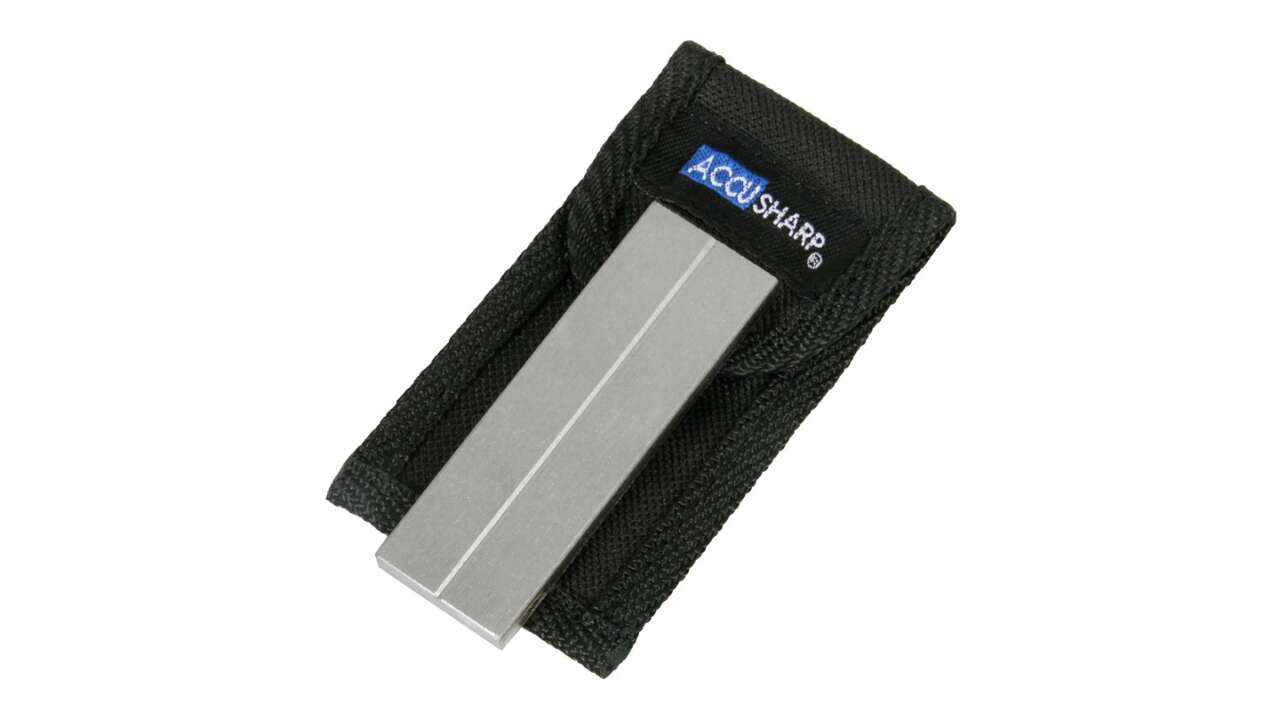
The AccuSharp Pocket Stone is an actual sharpening stone that fits in a pocket: 3 inches of dual-grit diamond plate that puts the sharpening angle back in your hand. Pull-through sharpeners make the opposite call, fixed carbide slots that do the thinking for you and take the say out of your edge.
It costs $13.99, weighs 3.2 ounces, and rides in a nylon pouch with a belt loop. For a knife carrier, that’s the whole pitch: real stone sharpening that fits the same pocket as the knife.
Price: $13.99
Where to Buy: Amazon
Two faces, a groove, and a pouch
One face is 320-grit diamond, the coarse side, bonded to a metal plate. Flip it over and the other face is 800-grit diamond for honing and finishing. Diamond is the right abrasive call at this size: it cuts fast on modern folder steels, works dry or with a splash of water, and never dishes out or needs flattening the way a bench stone does.
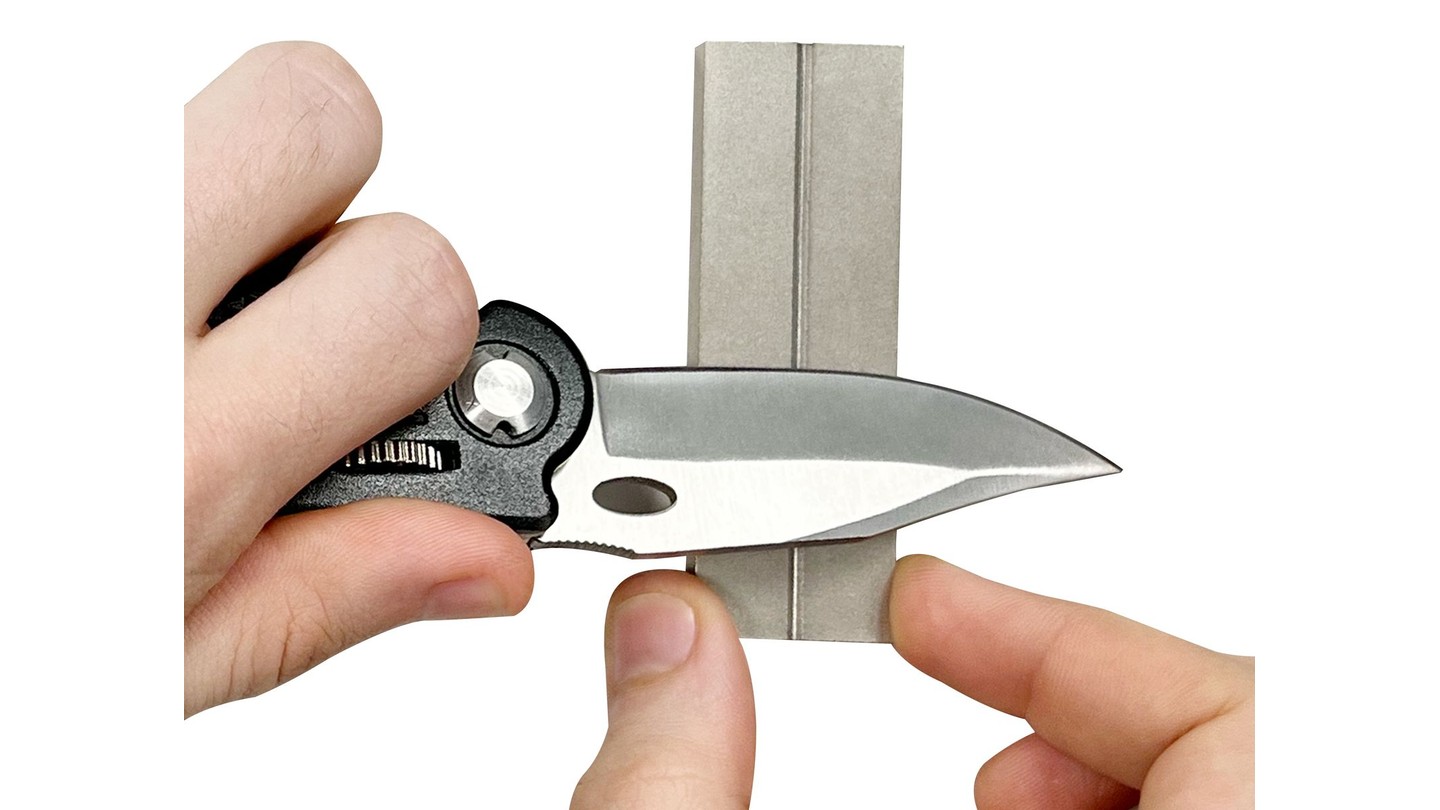
A groove runs down the stone for fish hooks and darts, the pointed gear a flat face can’t serve. The pouch is plain nylon with a loop for a belt or a pack strap. Nothing about it is fancy, and nothing needs to be.
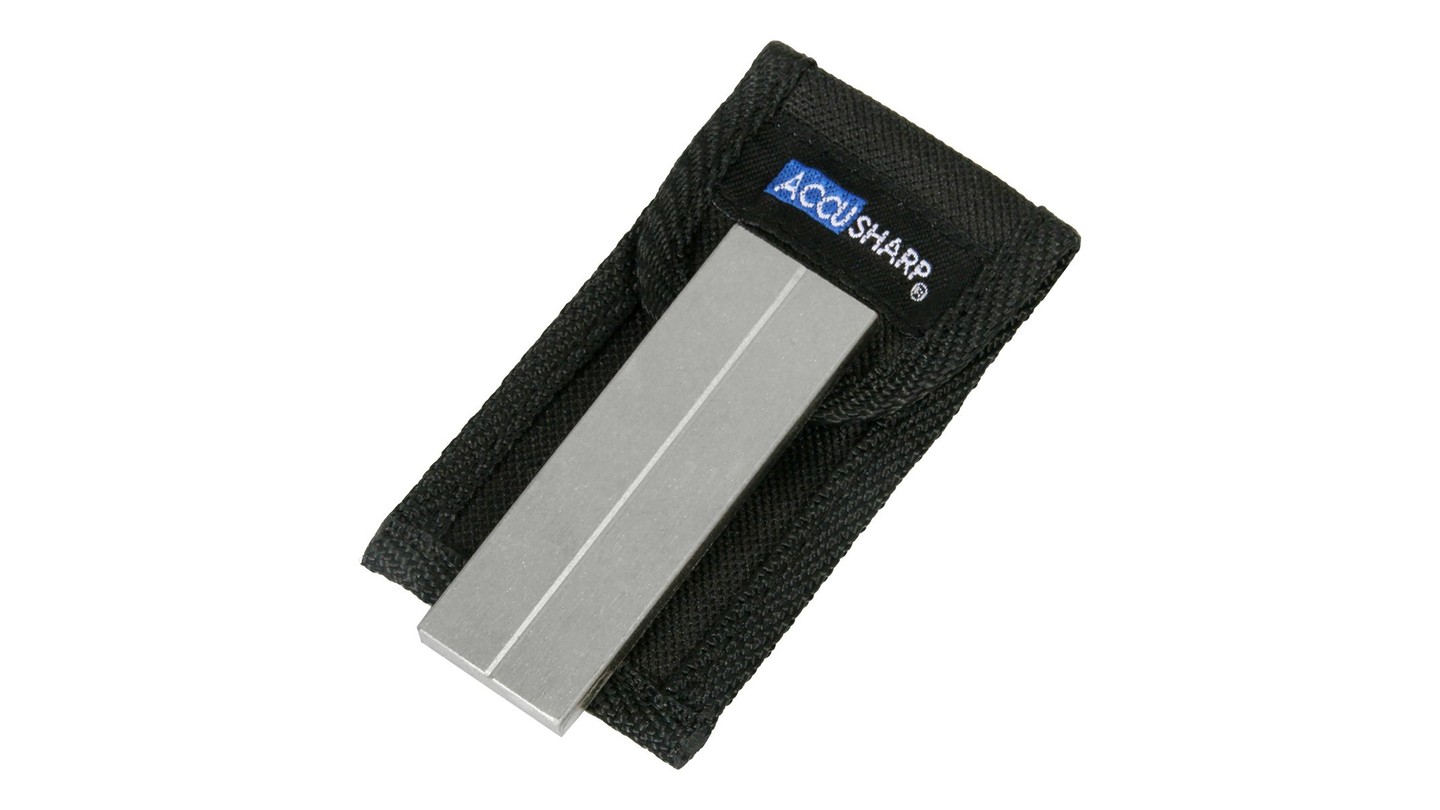
Diamond instead of a classic stone
A traditional pocket stone, Arkansas or oilstone, cuts slowly and wants oil or water management to keep its surface from loading up with swarf. Diamond plate skips all of that. The abrasive sits on the surface, so it cuts from the first stroke, rinses clean under a tap, and holds its shape instead of wearing into a saddle.
It also cuts the steels that shrug off natural stones. The hard, high-carbide alloys in current folders, the MagnaCut and S35VN class, need an abrasive harder than the carbides inside the blade itself. Diamond is the common abrasive that qualifies, and it’s why a $13.99 plate can work on a $175 folder without apology.
How do you sharpen on 3 inches of stone?
Freehand sharpening is a skill, and the stone doesn’t hide that. Hold the blade at a steady angle, roughly 20 degrees for most folders, and draw it across the coarse face with light pressure. Diamond cuts aggressively, so muscle works against you. Let the grit do the job.
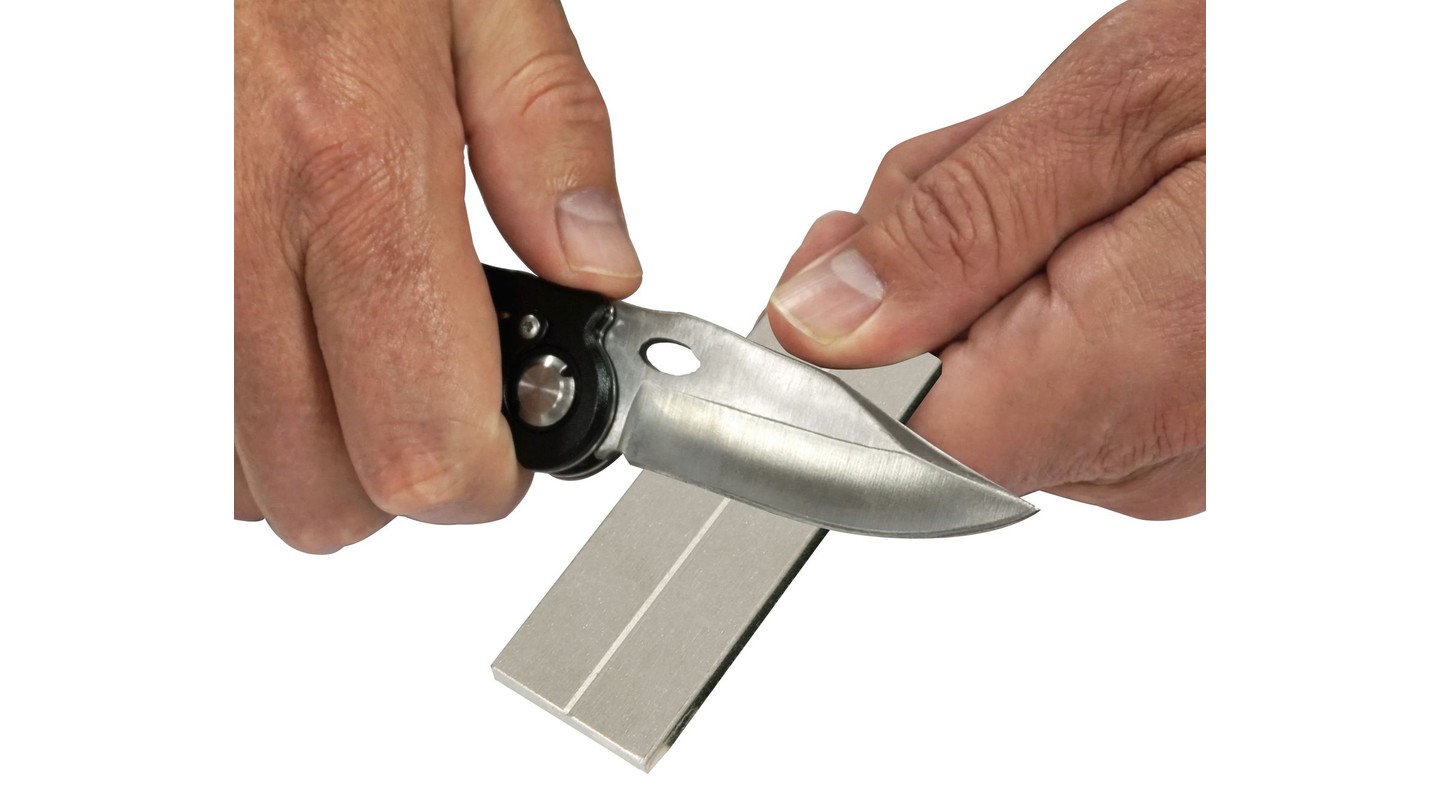
The tell that you’re done on one side is the burr: a faint wire of metal you can feel along the opposite edge with a fingertip. Raise a burr along the whole blade, flip, and repeat. Then let the 800 side take the burr off with lighter and lighter strokes. That sequence, coarse to fine, burr to clean, is the entire method. Everything else is practice.
Start on the 320 side when an edge is genuinely dull or nicked, and use the 800 side alone for the weekly touch-up. A rinse and a wipe dry, and the stone goes back in its pouch. Three inches covers a folding knife’s blade in one pass, which is the job this tool exists for.
Stone or pull-through
A pull-through is faster and nearly foolproof, and for a beater knife that lives in a toolbox drawer, fast and foolproof wins. The cost shows up over time: fixed carbide slots peel metal off the edge and lock every blade into the same geometry, whether that geometry suits the knife or not.
A stone preserves your choices. You pick the angle, you work the whole edge including the curve toward the tip, and you can touch up hooks, awls, and other small tools that will never fit through a slot. Gadgeteer covered the SHARPAL 101N, a pocket pull-through loaded with extras, and it earns its place for the opposite reason: zero learning curve. The AccuSharp asks for a weekend of practice and pays it back every time you sharpen.
Where a 3-inch stone runs out of road
Serrated edges are the hard limit. A flat stone can’t get into serrations; that job wants a tapered rod. Long kitchen blades are the other stretch. You can sharpen a chef’s knife on 3 inches of stone in sections, and plenty of people do, but a full-size bench stone does it better and faster. This is a folder and field tool, priced and sized like one.
It also can’t fix a broken tip or a deep chip in reasonable time. The 320 face is coarse for a pocket stone, not coarse for a repair shop. Know the line and the little stone stays honest.
The cost, and what else the money buys
AccuSharp’s own price sheet lists this stone at $13.99, and Amazon sells it for the same $13.99. At that money, the real comparison isn’t other stones. It’s the gas-station pull-through at the same price that eats edges, or the guided sharpening system at four times the price that stays home in a drawer because the kit is too much trouble to set up.
There’s no kit here. No guide rods, no clamps, no oil bottle, nothing to assemble at a tailgate or a campsite table. The stone, the pouch, and your two hands are the whole system, and the system fits in a jeans pocket.
Price: $13.99
Where to Buy: Amazon
Riding in your pocket
If you carry a folder daily and touch it up where you stand, at the workbench, in the truck, on the water with hooks to dress, yes. The AccuSharp Pocket Stone is the cheapest way to own the actual skill of sharpening instead of renting it from a plastic slot. If your knives meet a sharpener once a year and you want the edge handled for you, buy the pull-through and don’t feel bad about it.