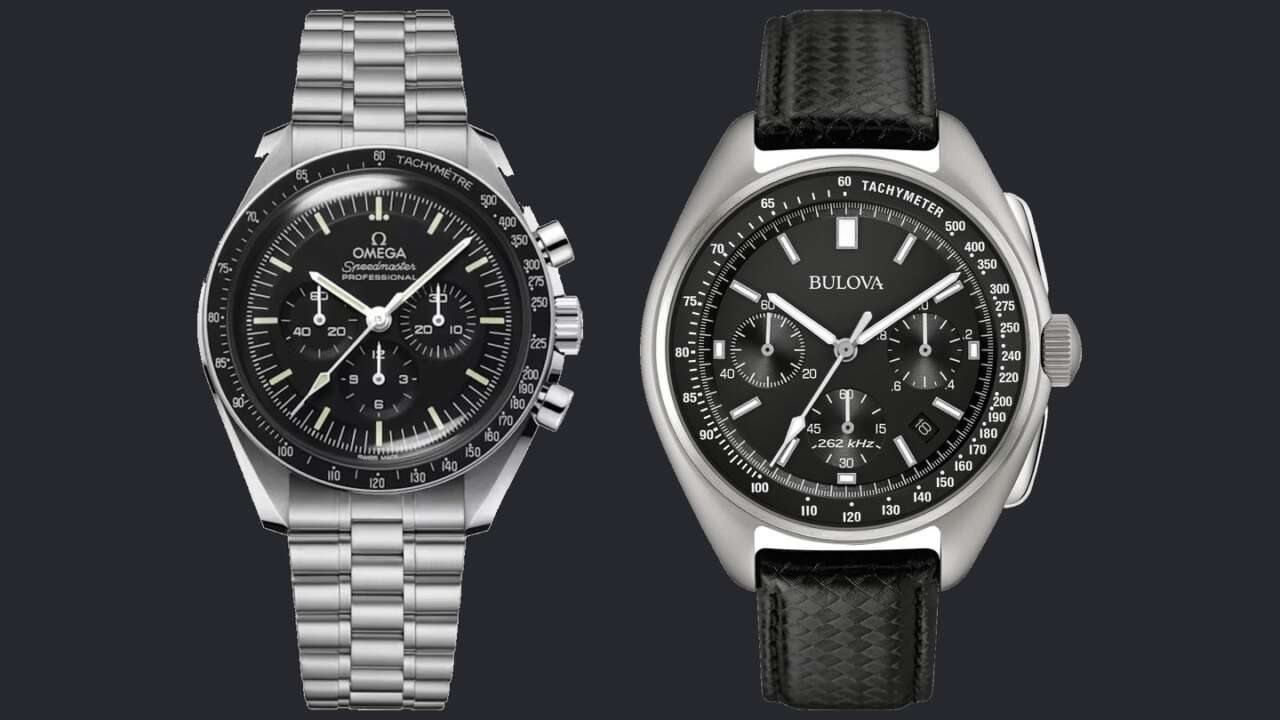
Twelve men have walked on the Moon. Every one of them wore an OMEGA Speedmaster on the outside of his suit, and the watch has traded on that fact for half a century. Fair enough. But the Speedmaster isn’t the only watch that has stood on the lunar surface, and the other one costs $461.93.
The other watch is a Bulova. It flew as a backup, got its chance when the issued watch broke, and came home with the stranger story of the two. Both watches are still on sale today, one at $7,800 and one under $500, which raises the question this pairing exists to answer: what does the extra money buy, and where does the cheap watch close the gap?
The price gap runs about seventeen to one. It doesn’t buy everything.
A backup watch’s trip to the Moon
Apollo 15, August 2, 1971. Commander Dave Scott was working through his second spacewalk at Hadley Rille when the crystal on his NASA-issued Speedmaster popped off. In his personal kit sat a watch Bulova had given him, a chronograph prototype the company had built for lunar conditions. He strapped it on for the third spacewalk, over the cuff of the suit. It stayed on his wrist for the rest of the mission.
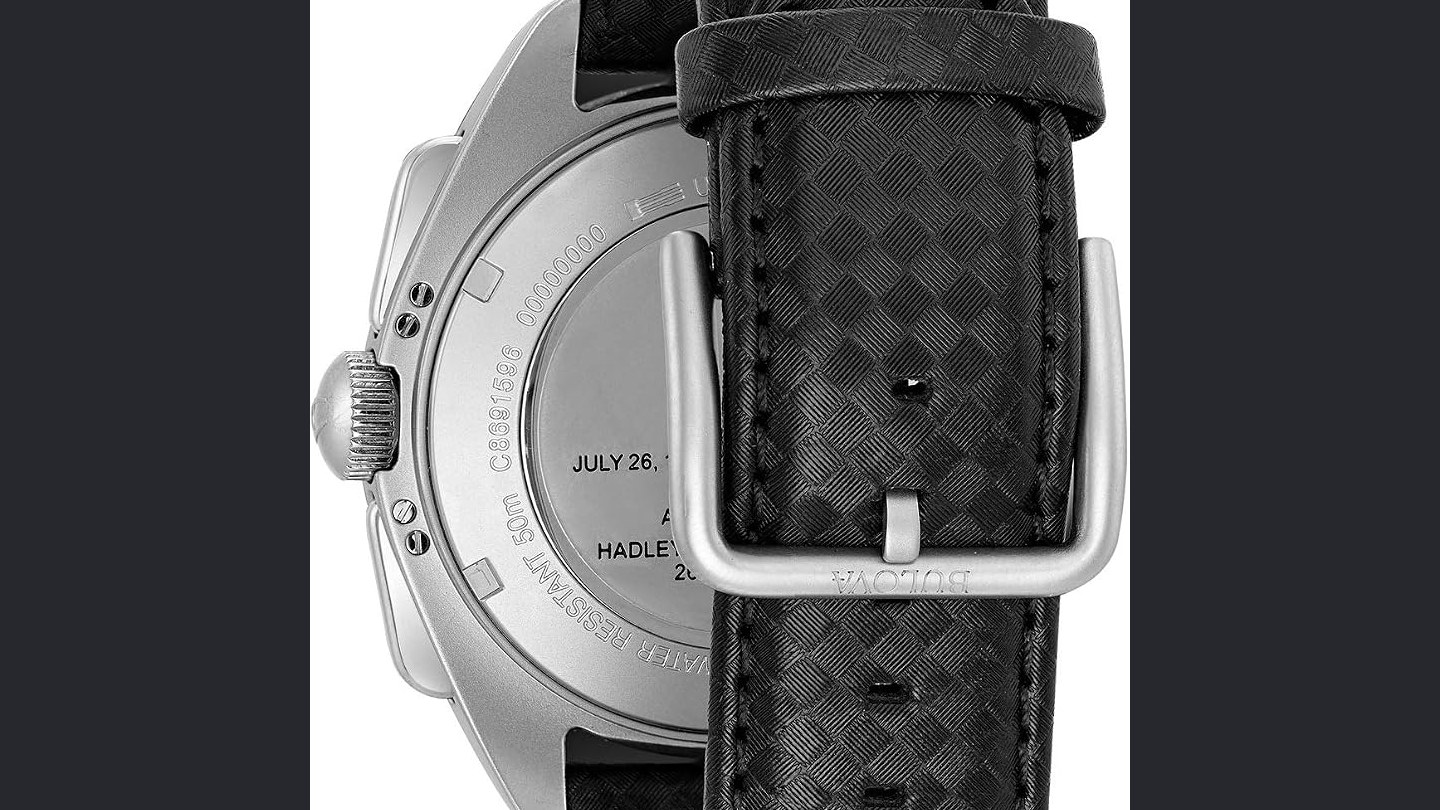
That made Scott’s Bulova the only privately owned watch ever worn on the Moon’s surface. The Speedmasters belonged to NASA and stayed government property. Scott kept his, held it for 44 years, and sold it at auction in 2015 for $1.6 million. Bulova put the design back into production a year later and called it the Lunar Pilot.
The issued watch’s record needs no rescue. The Speedmaster was the only watch to pass NASA’s full qualification battery in 1965, it flew on all six landings, and it’s stayed in production ever since. NASA’s crews still wear an OMEGA in orbit today, though the current issue is a quartz Speedmaster X-33, a very different watch that we have covered on its own, and one NASA still issues today.
The flown Speedmasters were not ceremony. OMEGA calls the watch the critical backup if the digital timers ever failed on board, and on Apollo 13 the crew timed a course-correction burn on one after the explosion. That’s the résumé the current watch inherits, and OMEGA has never had to embellish it. Not once in six decades.
The Speedmaster is still the original formula
The current Moonwatch Professional, reference 310.30.42.50.01.001, keeps the flown shape. Its asymmetrical 42mm steel case follows the fourth-generation design Aldrin wore in 1969. The crystal is hesalite, the acrylic OMEGA fitted to the space watches because it flexes instead of shattering. Under it sits the black step dial, and the caseback is closed steel.
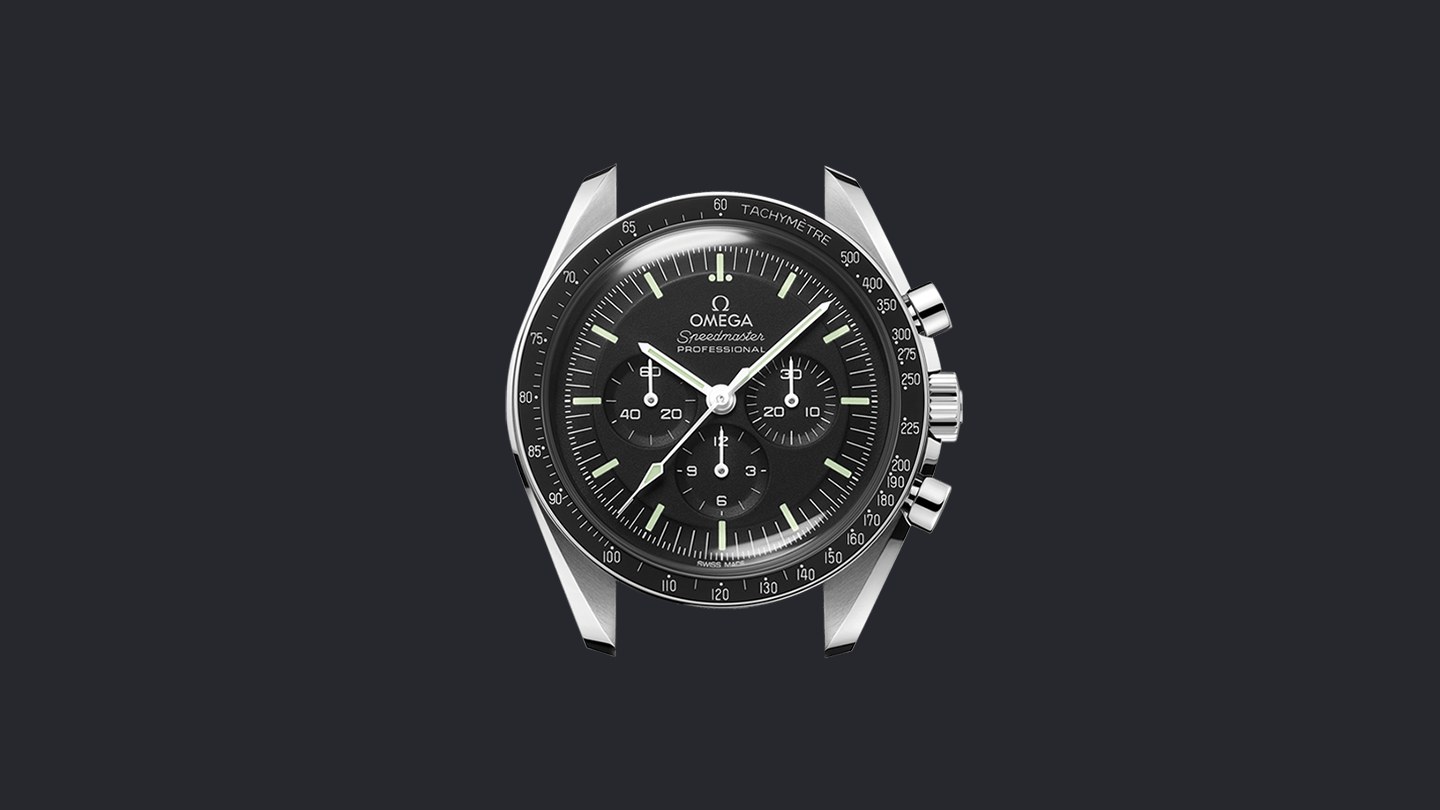
Same case. Same dial layout. New heart.
The Calibre 3861 is the modern part. It’s a hand-wound chronograph, the first Master Chronometer movement in a Moonwatch, and METAS certifies the finished watch rather than the movement alone. It shrugs off magnetic fields up to 15,000 gauss, beats at 3 Hz, and runs 50 hours on a wind. The dot over the 90 on the bezel stays, a 1960s quirk OMEGA refuses to tidy away.
OMEGA Speedmaster Moonwatch Professional 310.30.42.50.01.001
Calibre 3861 Master Chronometer · 42mm steel case · Hesalite crystal
Price: $7,800
Where to buy: Buy at OMEGA
The hesalite on steel is also the cheapest way into the current Moonwatch line. The sapphire-crystal version runs $9,000 on the same bracelet. The hesalite on a coated nylon strap drops to $7,400.
The Lunar Pilot runs on frequency instead of gears
Bulova’s reissue, the 96B251, scales Scott’s prototype up. The steel case runs 45mm across and 13.5mm thick, with a sapphire crystal over a black dial that mirrors the original’s layout, small date window included. The set ships with two straps, a black leather and a black nylon, both interchangeable on the same lugs.
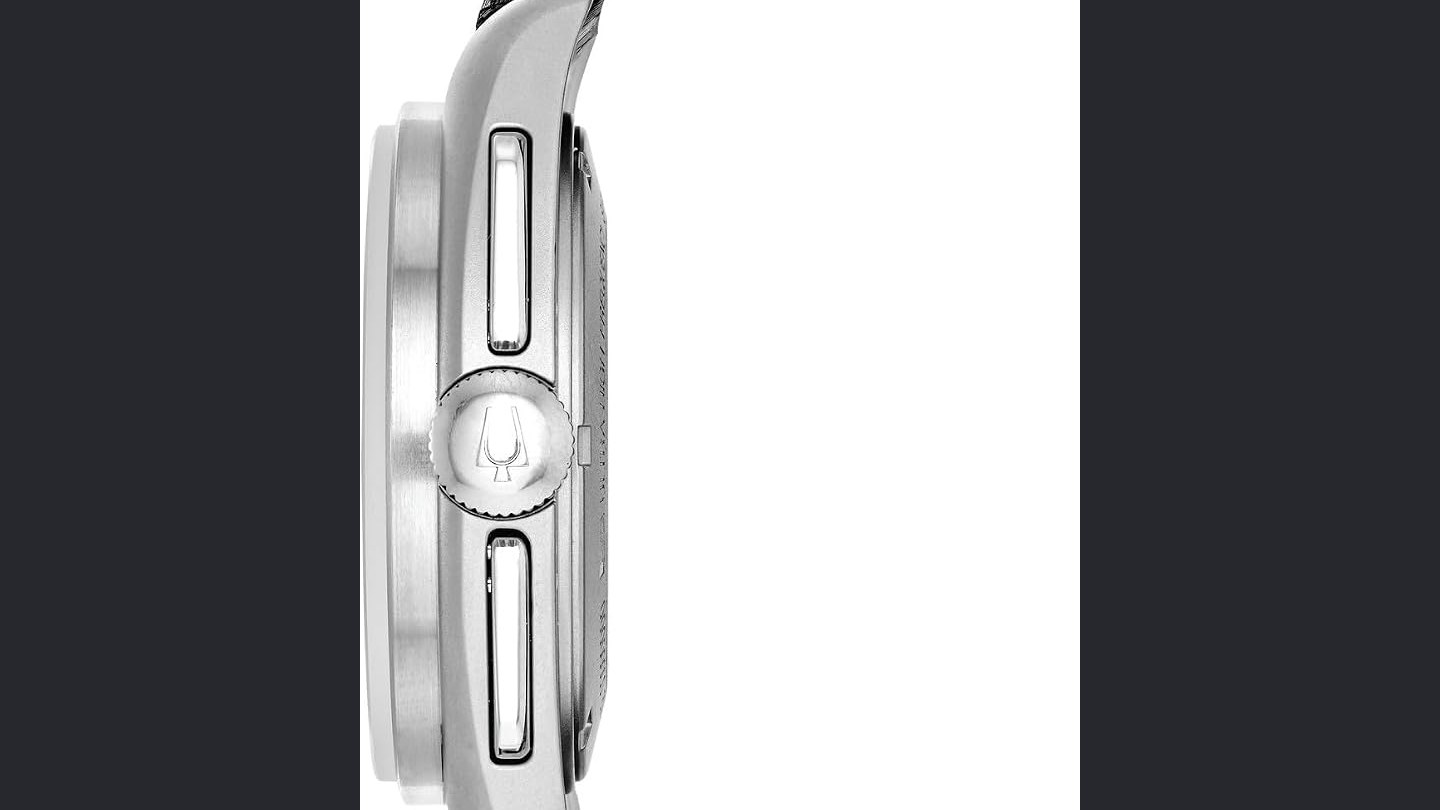
The movement is the counterpunch. Bulova’s high-performance quartz vibrates at 262 kHz, eight times a standard quartz crystal, and Bulova rates the accuracy at seconds per year. Watch the chronograph hand and it glides in small steps instead of ticking, the way a mechanical one does. Against a mechanical watch that drifts seconds a day, the Bulova wins timekeeping outright, and asks only for a battery swap now and then.
Bulova Lunar Pilot 96B251
262 kHz high-performance quartz · 45mm steel case · Sapphire crystal · Two straps in the box
Price: $461.93
Where to buy: Buy on Amazon
Upkeep flips the gap. No winding, no service calendar, no specialist with a loupe.
Bulova keeps building on the line, too. The Lunar Pilot shrank to 43.5mm in a later reference, and this year it went to 41mm in black for the Black Hole edition, a watch we covered when it landed.
Where the gap shows, and where it closes
| Speedmaster Moonwatch Professional | Lunar Pilot 96B251 | |
|---|---|---|
| Movement | OMEGA Calibre 3861, hand-wound mechanical | High-performance quartz, 262 kHz |
| Case | 42mm stainless steel | 45mm stainless steel |
| Crystal | Hesalite | Sapphire |
| Water resistance | 5 bar (50 meters) | 50 meters |
| Power | 50-hour reserve, wound by hand | Battery, no winding |
| Price | $7,800 | $461.93 |
Size splits them, too. The Speedmaster wears compact for a chronograph, all case curve and bracelet drape. The Bulova stands 45mm across and 13.5mm tall, and it looks every bit of it on a smaller wrist. The cheap watch is the bigger commitment before price even enters it.
The money in the OMEGA goes to the movement first, a mechanical chronograph certified as a finished watch, and to the depth of the thing behind it: unbroken production, a global service network, and a secondary market that treats the Moonwatch as a store of value. None of that shows on the dial. All of it shows in the ownership.
Accuracy is a rout, and it isn’t close.
What the gap can’t buy is a better claim on the Moon. Both watches were there, on wrists, in the dust. One was issued to the crew. The other got called down from the bench when the starter broke, and finished the mission. Collectors pay for the first story. The second one isn’t a consolation prize.
So the pick comes down to which kind of Moon history you want to own. The OMEGA is the instrument NASA chose, still built the slow way, at $7,800. The Bulova is the understudy that played the lead for a day, at $461.93. Either way, the watch on your wrist has been somewhere no other product category can claim. It’s been to the Moon and back.