Every dive watch on sale today runs on a formula written in 1953. A rotating bezel to track the dive, luminous markers big enough to read through a mask, a case sealed well enough to trust with your life. Blancpain’s Fifty Fathoms set that template first, and the references that carried it through the fifties and sixties are the ones collectors chase hardest.
Five of them tell the story. A French combat swimmer’s tool, a smaller sibling built for daily wear, an American spec piece with a moisture alarm on its dial, a German frogman’s watch wearing a radiation warning as a logo, and a contract watch that never carried the Blancpain name at all. Here is the lineage, in the order it happened, reference by reference.
The 1953 original came out of a dive that nearly went wrong
The Fifty Fathoms exists because Jean-Jacques Fiechter ran out of air. Blancpain’s co-CEO was diving off Cannes when his tank emptied underwater, and the near miss settled it for him: a dive watch had to be a real instrument, built for the water before anything else. The French Navy had the same problem from the other side. Captain Robert Maloubier and Lieutenant Claude Riffaud were standing up the Nageurs de Combat, France’s first combat swimmer unit, and their divers needed a watch that could be read at depth and trusted completely.
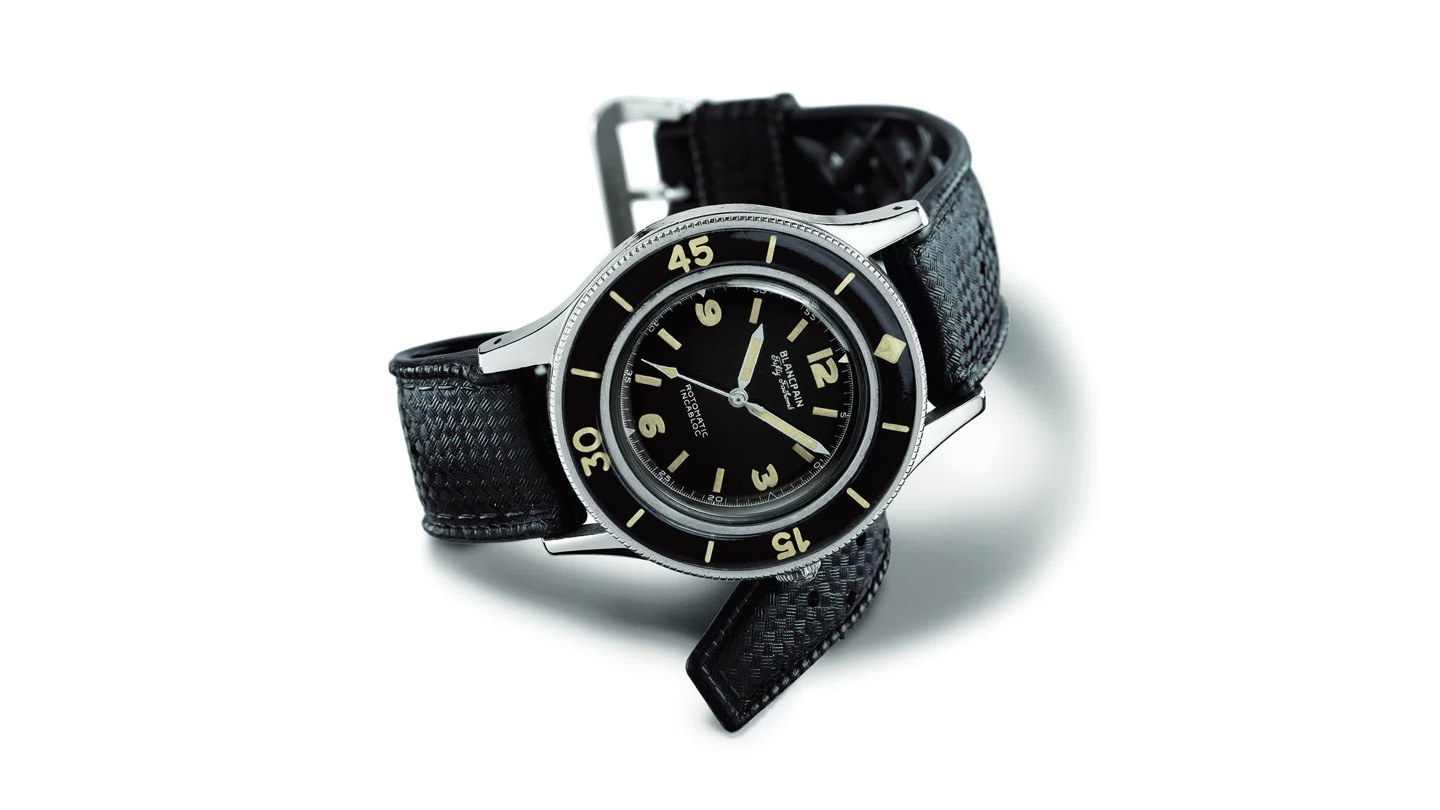
What Fiechter patented reads like the checklist every dive watch still follows. A locking rotating bezel, so a knock against a wreck couldn’t shift the dive-time scale. A double-seal crown. A caseback built around an O-ring channel, so the seal never distorted as it was fitted.
A soft-iron inner case to shrug off magnetism, and automatic winding, so the crown could stay sealed instead of being opened to wind. The case ran 40 to 41mm at a time when men’s watches sat between 32 and 34mm, and the name was pure depth math. Fifty fathoms is about 91.5 meters, as deep as a diver could go on the oxygen mixes of the day. Cousteau’s divers wore it on film, and the dive watch had its template.
The Bathyscaphe shrank the formula for daily wear
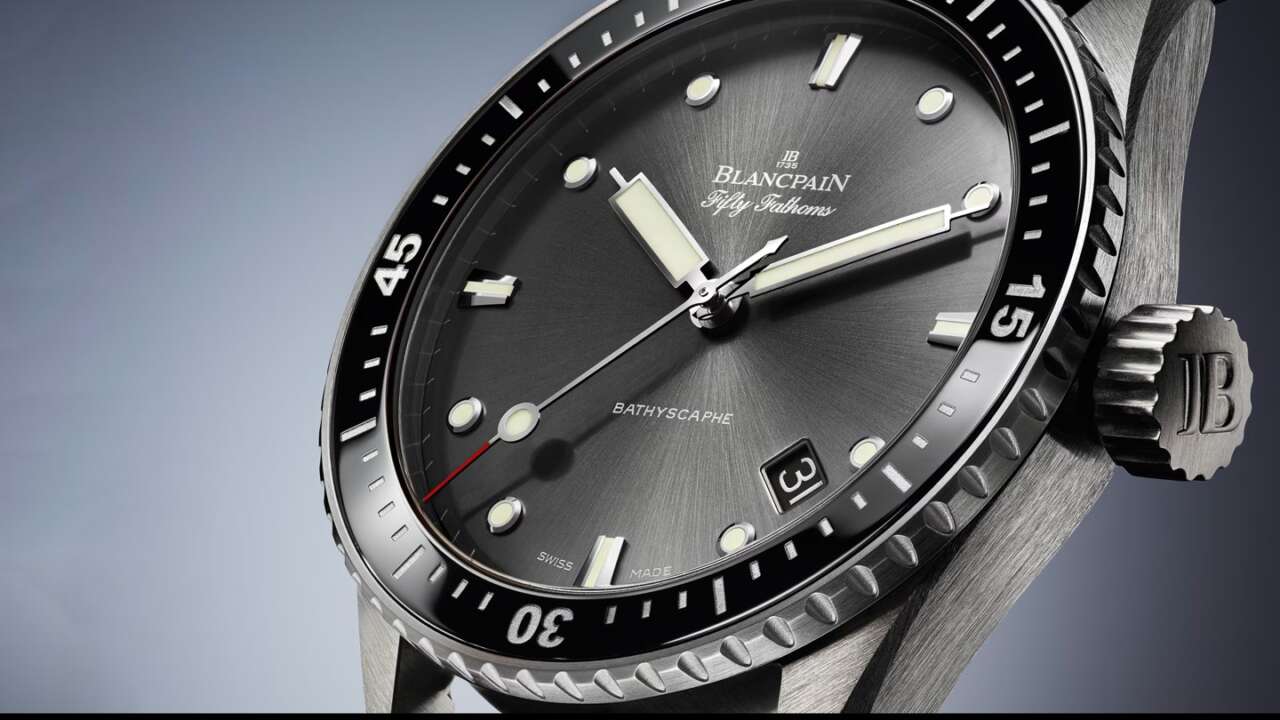
Fiechter registered the Bathyscaphe name in 1953, borrowing it from Auguste Piccard’s deep-diving vessel, and the watch itself followed in 1956. The brief was simple. Keep the Fifty Fathoms’ dive credentials, cut the case to roughly 37mm, thin the bezel, slim the profile, add a date window, and the issued tool becomes a watch a civilian could wear every day, on land as much as at sea.
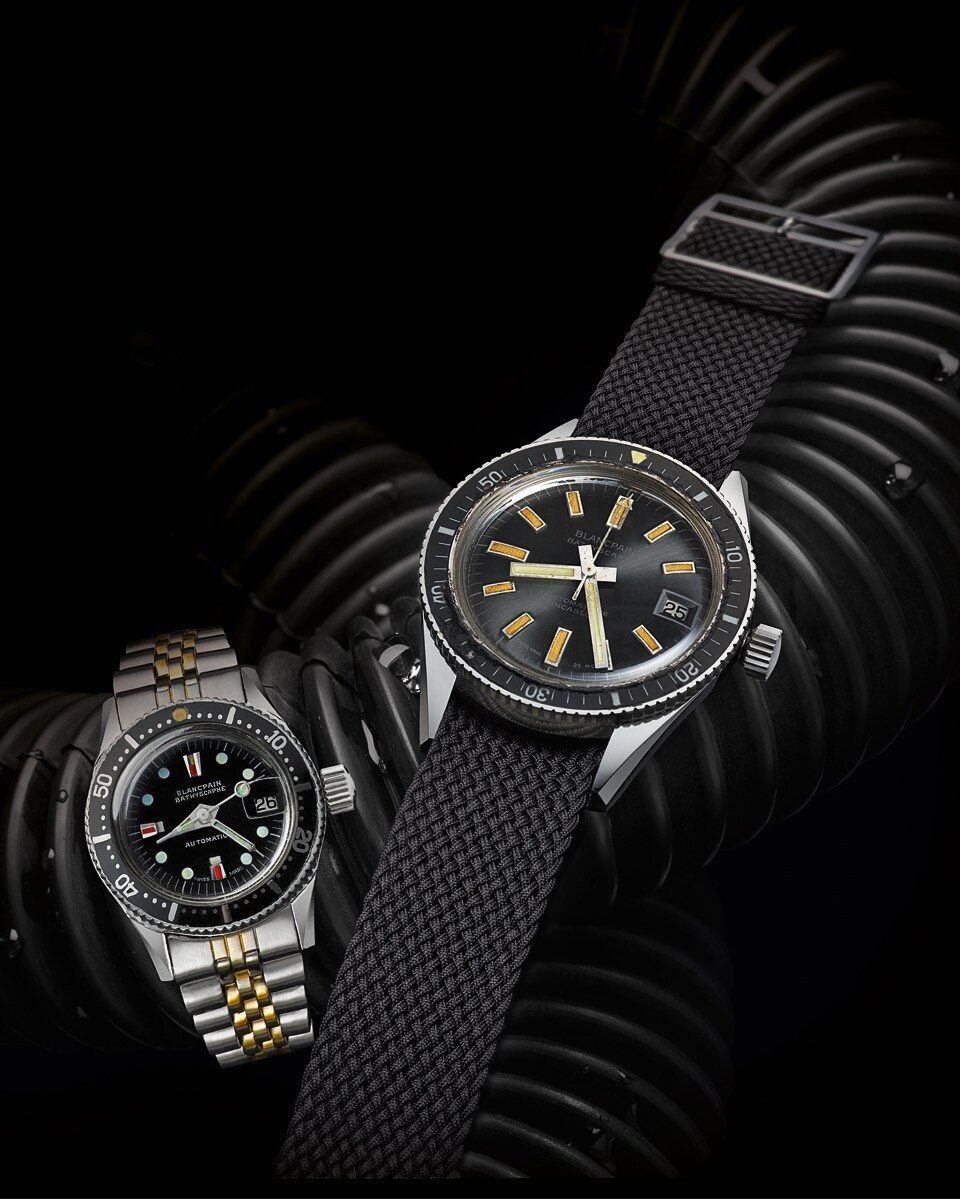
That smaller watch is where the Fifty Fathoms line stopped being pure equipment. A second generation arrived through the sixties, and the 1968 model is the one Blancpain itself calls emblematic. Then the name went quiet for decades, until Blancpain revived the Bathyscaphe in 2013. It still runs on Fiechter’s second brief: the diver, sized for a normal wrist. Today’s Bathyscaphe range works the same spread of sizes the vintage line did, from 38mm to 43mm.
The MIL-SPEC put a moisture alarm on the dial
America’s turn came in 1957 and 1958, when the US Navy adopted the Fifty Fathoms to its MIL-SPEC standard. Navy testing ran through the Operation HARDTACK series in 1958, and the verdict Blancpain quotes to this day is ‘virtually complete satisfaction’. It was the only model that met every criterion the Navy had laid down for its underwater missions.
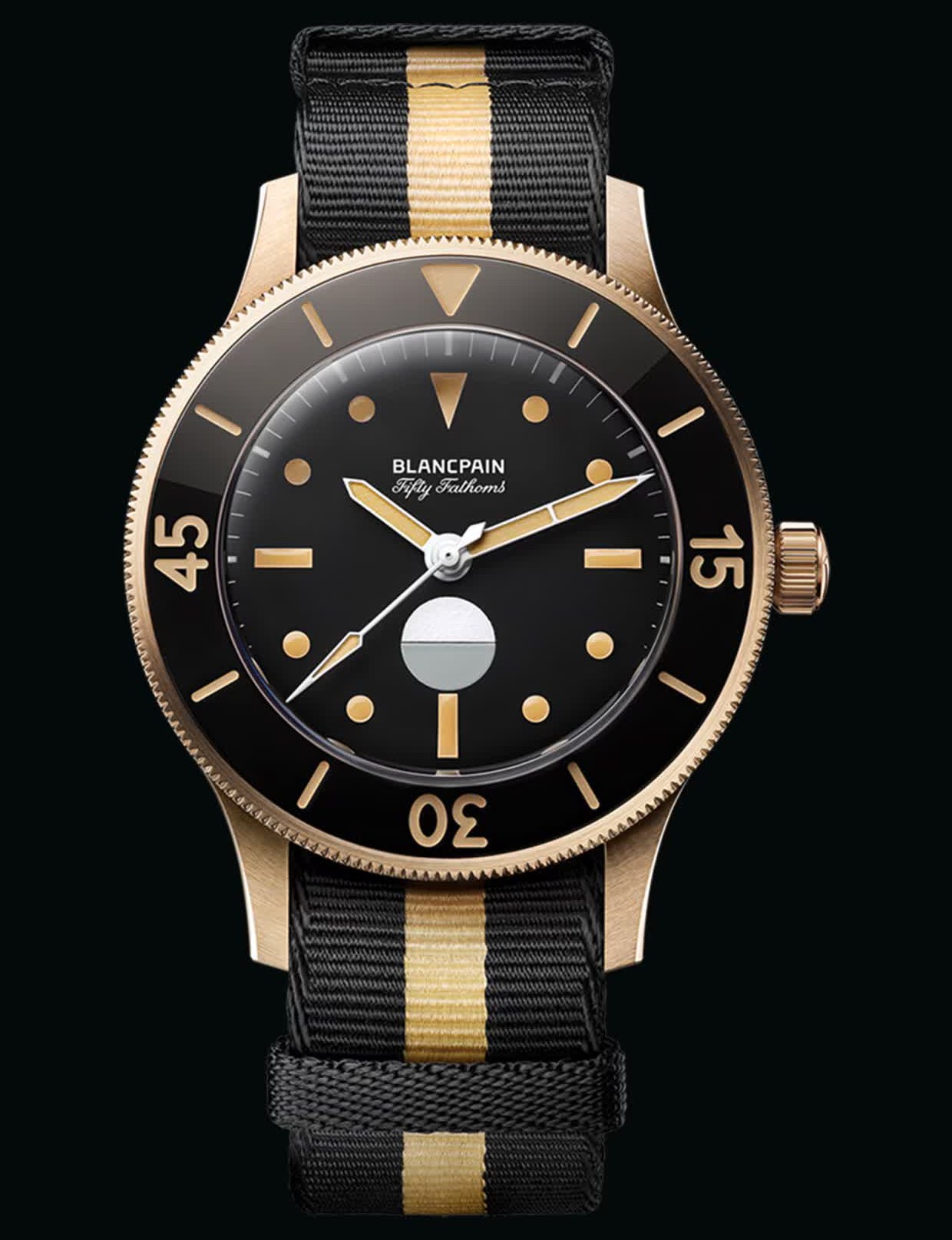
The signature detail is the small disk at 6 o’clock. It is a moisture indicator, white in normal use, that turns red from the bottom up if water breaches the case. A navy issuing watches to divers it would never personally inspect got a yes-or-no answer at a glance: is this one still sealed? Fiechter had developed the indicator through the fifties, and on the MIL-SPEC it became part of the specification itself. When Blancpain marked 70 years of the Fifty Fathoms in 2023, the Act 3 tribute rebuilt this watch in 9K Bronze Gold, 555 pieces, indicator exactly where it belongs.
The Bund No Rad wore its safety warning as a logo
By the early sixties radium lume was a known hazard, and Blancpain printed the all-clear straight onto the dial. The no radiations logo, three red segments on a yellow ground crossed through in black, told the wearer the markers held no radium at all. It was the first mark of its kind on a Fifty Fathoms dial, and it made the watch.
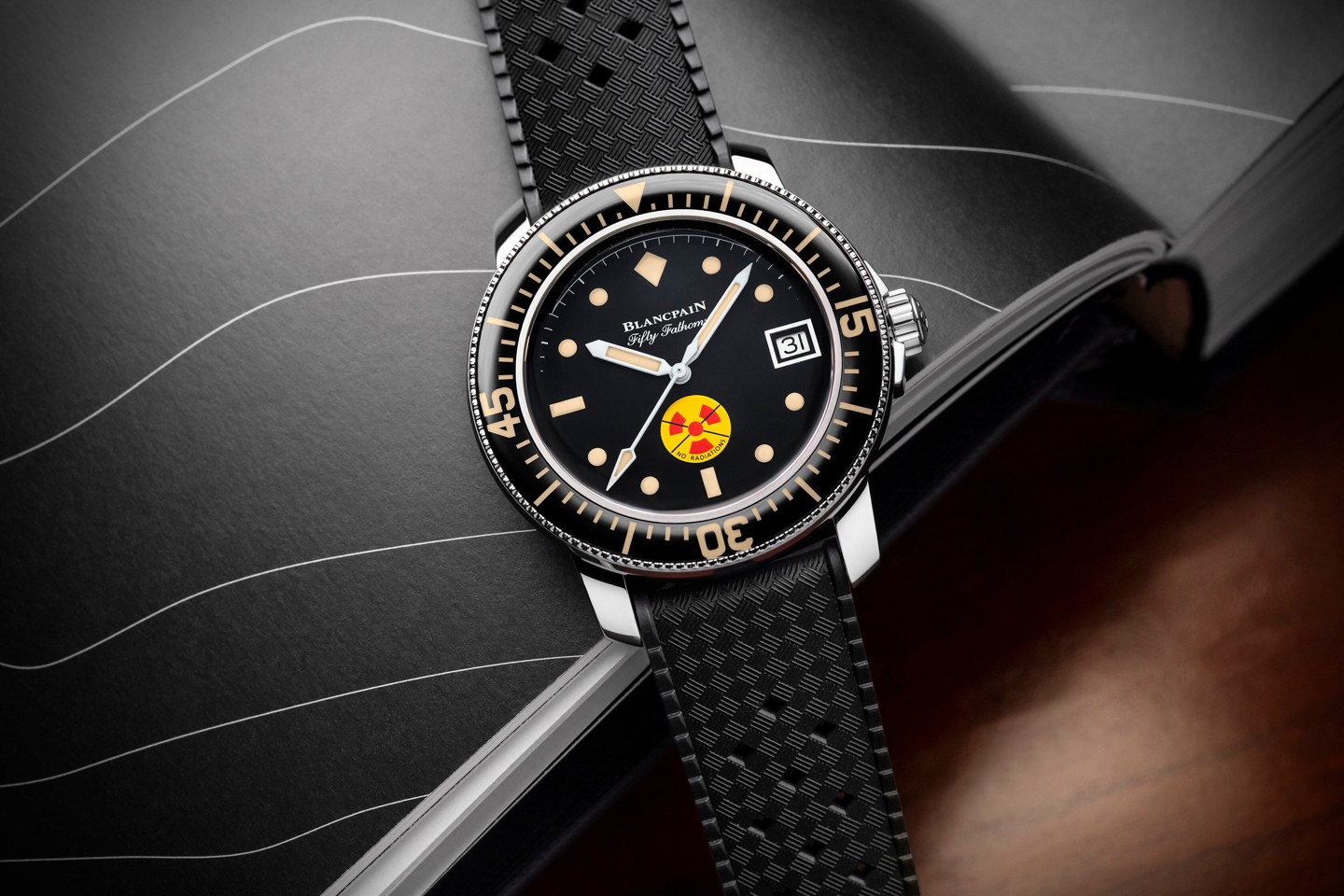
Germany’s Bundeswehr issued the watch as the Fifty Fathoms RPG 1, and the Kampfschwimmer, the navy’s combat swimmers, carried it into the early seventies with ‘Bund’ engraved on the casebacks. Surviving issued examples are scarce, and the dial has become the most collectible graphic in the line’s history.
Blancpain’s 500-piece Tribute to Fifty Fathoms No Rad of 2021 sold on that logo’s strength alone.
The TR-900 hid the Blancpain name to win a US Navy contract
The strangest Fifty Fathoms of all never said Blancpain anywhere on it. The Buy American Act kept foreign-made watches out of US military contracts, so the work routed through Allen Tornek, Blancpain’s American importer, and his Swiss supply line at Rayville of Villeret, the village’s name rearranged into an anagram. The Navy had asked American makers to build 1,000 watches to its specification. None of them would take the job. Tornek would.
The specification, MIL-W-22176A(SHIPS), asked for a lot. A watch good to 400 feet. Accuracy within 30 seconds a day. Zero magnetic signature, because a magnetic case near naval mines is a hazard nobody signs off on.
Inside the matte, grained steel case sat an A. Schild AS 1361N automatic, and the dial carried the moisture indicator and Promethium-147 lume. Deliveries ran through 1964 and 1965, an initial order of 780 watches at $187.50 apiece and a follow-up of just under 300, a little over 1,000 in total.
Most were later destroyed as low-level radioactive waste. Perhaps 20 survive. The TR-900 is the rarest chapter of the Fifty Fathoms story, and the one money alone won’t reliably buy you.
Today’s Fifty Fathoms Automatique is the same watch, grown up
The line never actually stopped. The current Fifty Fathoms Automatique descends in a straight line from Fiechter’s 1953 tool, with the case grown to 45mm in steel and a sapphire bezel insert. Inside sits the caliber 1315, good for 120 hours of power reserve, five days off the wrist. Water resistance runs to 30 bar, more than three times the depth the name promises.
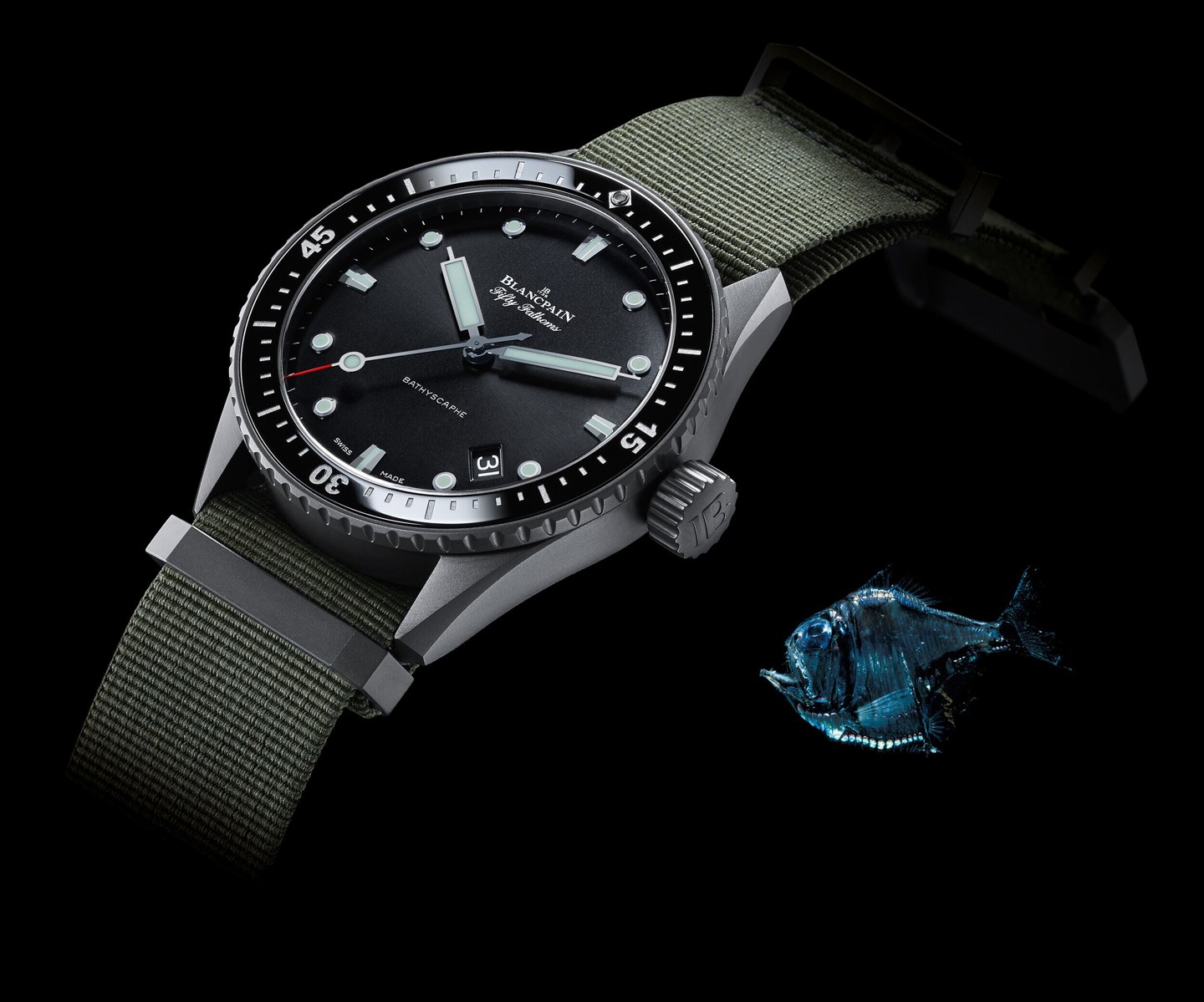
The Bathyscaphe runs alongside it, 43mm and smaller, the daily-wear brief intact. Blancpain sells the Automatique through its own US store at $19,100 on the sail-canvas strap, and Fiechter would recognize the watch at a glance. Same bezel logic, same oversized markers, same job to do. Seventy years on, the formula has never needed rewriting.
Fifty Fathoms Automatique
45mm steel case · Caliber 1315, 120-hour power reserve · 30 bar water resistance
Price: $19,100 at Blancpain
Where to buy: Buy at Blancpain